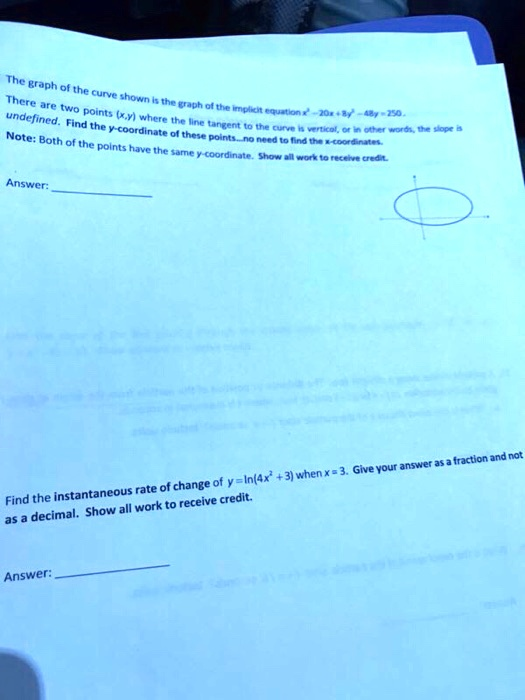
The graph of the curve shown is the graph of the implicit equation
The Correct Answer and Explanation is:
Here are the solutions to the problems shown in the image.
Problem 1:
The question asks for the y-coordinate of the points on the curve x² – 20x + 8y² – 48y = 250 where the tangent line is vertical. A vertical tangent line occurs where the slope, dy/dx, is undefined. This typically happens when the denominator of the derivative expression is zero.
To find the derivative, we use implicit differentiation on the given equation with respect to x:
d/dx (x² – 20x + 8y² – 48y) = d/dx (250)
Differentiating each term gives us:
2x – 20 + 16y(dy/dx) – 48(dy/dx) = 0
Now, we solve for dy/dx. First, we group the terms containing dy/dx:
16y(dy/dx) – 48(dy/dx) = 20 – 2x
Factor out dy/dx:
(16y – 48) dy/dx = 20 – 2x
Isolate dy/dx by dividing:
dy/dx = (20 – 2x) / (16y – 48)
The slope dy/dx is undefined when the denominator is zero. We set the denominator equal to zero and solve for the y-coordinate:
16y – 48 = 0
16y = 48
y = 48 / 16
y = 3
Answer: 3
Problem 2:
This question asks for the instantaneous rate of change of y = ln(4x² + 3) when x = 3. The instantaneous rate of change is found by calculating the derivative of the function, dy/dx, and then evaluating it at the specified x-value.
We need to differentiate y = ln(4x² + 3) using the chain rule. The derivative of a natural logarithm function, ln(u), is u’/u, where u is the inner function.
Here, the inner function is u = 4x² + 3.
The derivative of the inner function is u’ = d/dx(4x² + 3) = 8x.
Applying the chain rule, the derivative of y is:
dy/dx = u’/u = 8x / (4x² + 3)
Next, we evaluate this derivative at x = 3:
dy/dx |_(x=3) = (8 * 3) / (4 * (3)² + 3)
= 24 / (4 * 9 + 3)
= 24 / (36 + 3)
= 24 / 39
The question requires the answer to be a simplified fraction. Both the numerator and the denominator are divisible by 3:
24 ÷ 3 = 8
39 ÷ 3 = 13
The simplified fraction is 8/13.
Answer: 8/13