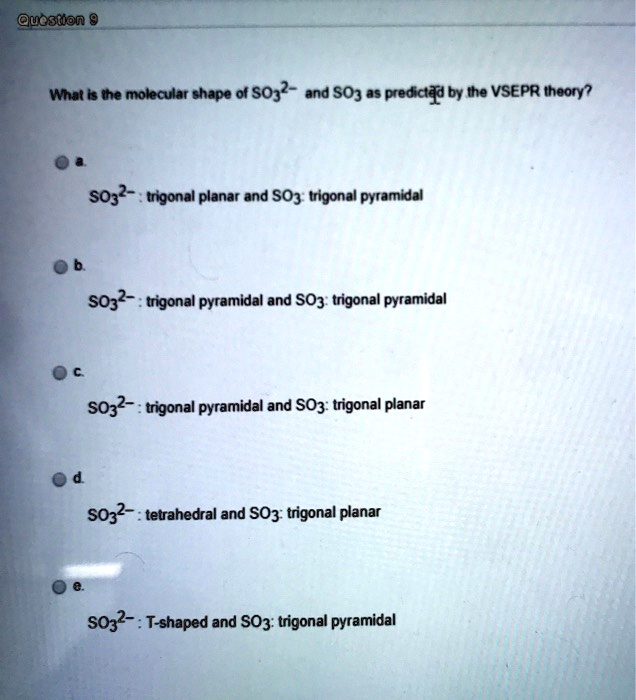
What is the molecular shape of SO 2/3
The Correct Answer and Explanation is:
The correct answer is c. SO₃²⁻: trigonal pyramidal and SO₃: trigonal planar.
Here is a step by step explanation based on VSEPR (Valence Shell Electron Pair Repulsion) theory:
1. Molecular Shape of the Sulfite Ion (SO₃²⁻)
First, we determine the Lewis structure for the sulfite ion.
- Valence Electrons: Sulfur (S) is in Group 16 and has 6 valence electrons. Oxygen (O) is also in Group 16 and has 6 valence electrons. The 2- charge adds 2 electrons.
Total valence electrons = 6 (from S) + 3 × 6 (from O) + 2 (charge) = 26 electrons. - Structure: Sulfur is the central atom as it is less electronegative than oxygen. It is bonded to three oxygen atoms.
- Electron Arrangement: After forming three single bonds (using 6 electrons), 20 electrons remain. Distributing these to the outer oxygen atoms to satisfy their octets uses 18 electrons (6 for each O). The final 2 electrons are placed on the central sulfur atom as a lone pair.
- VSEPR Analysis: The central sulfur atom has three bonding pairs (the S-O bonds) and one lone pair of electrons. This gives a total of four electron domains.
- Electron Geometry: Four electron domains arrange themselves in a tetrahedral geometry to minimize repulsion.
- Molecular Shape: With three bonding pairs and one lone pair (AX₃E₁), the lone pair repels the bonding pairs, pushing the oxygen atoms down. This results in a trigonal pyramidal molecular shape.
2. Molecular Shape of Sulfur Trioxide (SO₃)
Next, we determine the Lewis structure for sulfur trioxide.
- Valence Electrons: Sulfur has 6 valence electrons, and each of the three oxygen atoms has 6.
Total valence electrons = 6 (from S) + 3 × 6 (from O) = 24 electrons. - Structure: Sulfur is the central atom, bonded to three oxygen atoms.
- Electron Arrangement: To satisfy the octet rule for all atoms and minimize formal charges, the structure is best represented by three resonance structures, each having one S=O double bond and two S-O single bonds, or a single structure where sulfur has an expanded octet with three S=O double bonds.
- VSEPR Analysis: Regardless of the resonance structure used, the central sulfur atom is bonded to three other atoms and has no lone pairs. Each bond (whether single or double) counts as one electron domain. This gives a total of three electron domains.
- Electron Geometry: Three electron domains arrange themselves as far apart as possible, which is a trigonal planar geometry with 120° bond angles.
- Molecular Shape: Since there are no lone pairs on the central atom (AX₃), the molecular shape is the same as the electron geometry, which is trigonal planar.
Therefore, SO₃²⁻ has a trigonal pyramidal shape, and SO₃ has a trigonal planar shape.