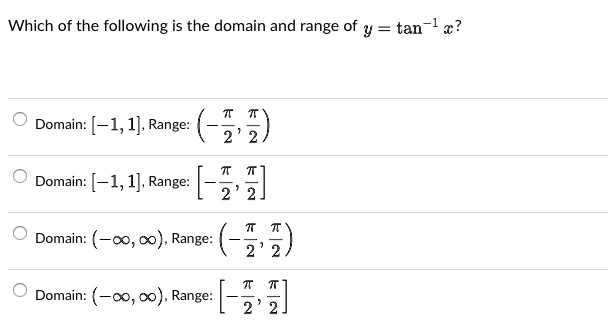
The Correct Answer and Explanation is:
The correct answer is:
Domain: (-∞, ∞), Range: (-π/2, π/2)
Explanation:
To understand the domain and range of the inverse tangent function, y = tan⁻¹(x), it is helpful to first consider the original tangent function, y = tan(x).
- The Tangent Function, y = tan(x):
- The tangent function takes an angle (in radians) as its input and gives a ratio as its output.
- The range of the tangent function is all real numbers. This means it can produce any value from negative infinity to positive infinity, written as (-∞, ∞).
- The domain of the tangent function is not all real numbers because it has vertical asymptotes at odd multiples of π/2 (e.g., … -π/2, π/2, 3π/2, …).
- Defining the Inverse Tangent Function, y = tan⁻¹(x):
- For a function to have an inverse, it must be one-to-one, meaning each output value corresponds to only one input value. The tangent function is periodic and not one-to-one over its entire domain.
- To define an inverse, we restrict the domain of tan(x) to a principal branch where it is one-to-one. The standard choice for this restricted domain is the open interval (-π/2, π/2). On this interval, the tan(x) function covers its entire range of (-∞, ∞).
- Swapping Domain and Range for the Inverse:
- The inverse function, y = tan⁻¹(x), essentially swaps the roles of the input and output from the original (restricted) function.
- The domain of tan⁻¹(x) is the range of the restricted tan(x). Since the range of tan(x) is (-∞, ∞), the domain of tan⁻¹(x) is also (-∞, ∞). This means you can take the inverse tangent of any real number.
- The range of tan⁻¹(x) is the domain of the restricted tan(x). Since the restricted domain of tan(x) is (-π/2, π/2), the range of tan⁻¹(x) is also (-π/2, π/2).
The parentheses in the range (-π/2, π/2) are crucial. They indicate an open interval, meaning the output values get infinitely close to -π/2 and π/2 but never actually reach them. This is because the graph of y = tan⁻¹(x) has horizontal asymptotes at y = -π/2 and y = π/2.