The Correct Answer and Explanation is:
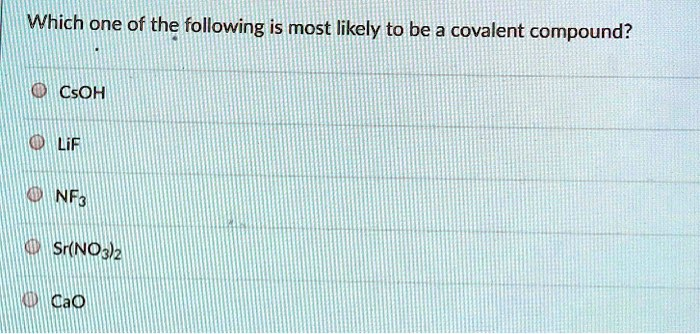
The correct answer is NF₃.
To identify the most likely covalent compound, we need to examine the nature of the atoms involved in each option. The type of chemical bond that forms between atoms is primarily determined by the difference in their electronegativity, which generally corresponds to whether the elements are metals or nonmetals.
Ionic bonds typically form between a metal and a nonmetal. Metals have low electronegativity and tend to lose electrons to form positive ions (cations). Nonmetals have high electronegativity and tend to gain electrons to form negative ions (anions). The strong electrostatic attraction between these oppositely charged ions constitutes an ionic bond.
Covalent bonds, on the other hand, typically form between two nonmetal atoms. Since nonmetals both have a high affinity for electrons, neither can completely pull electrons away from the other. Instead, they achieve stability by sharing valence electrons, forming a covalent bond and creating a distinct molecule.
Let’s analyze the options:
- CsOH (Cesium hydroxide): Cesium (Cs) is an alkali metal, and hydroxide (OH⁻) is a polyatomic anion. The compound consists of a metal cation (Cs⁺) and an anion, making it ionic.
- LiF (Lithium fluoride): Lithium (Li) is an alkali metal, and fluorine (F) is a halogen (a nonmetal). This combination of a metal and a nonmetal forms a classic ionic compound.
- Sr(NO₃)₂ (Strontium nitrate): Strontium (Sr) is an alkaline earth metal, and nitrate (NO₃⁻) is a polyatomic anion. This is an ionic compound held together by the attraction between the Sr²⁺ cation and the nitrate anions.
- CaO (Calcium oxide): Calcium (Ca) is an alkaline earth metal, and oxygen (O) is a nonmetal. This is another example of an ionic compound.
- NF₃ (Nitrogen trifluoride): Nitrogen (N) and fluorine (F) are both nonmetals. They will share electrons to form covalent bonds, resulting in a molecular compound. Therefore, NF₃ is the most likely covalent compound among the choices.