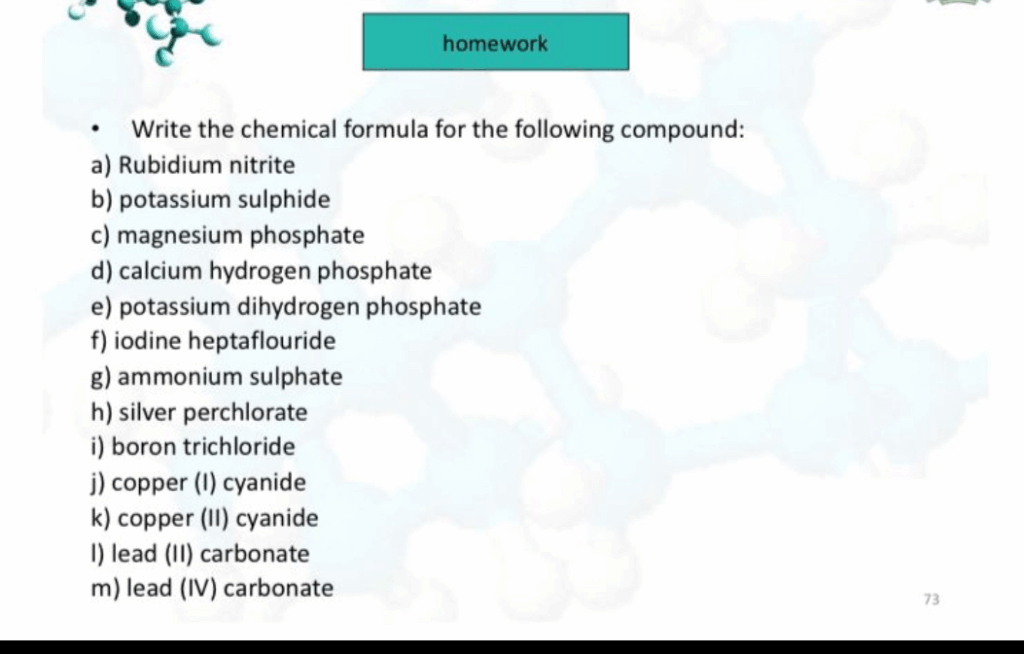
Write the chemical formula for the following compound
The Correct Answer and Explanation is:
Here are the correct chemical formulas for the compounds listed in the image.
a) RbNO₂
b) K₂S
c) Mg₃(PO₄)₂
d) CaHPO₄
e) KH₂PO₄
f) IF₇
g) (NH₄)₂SO₄
h) AgClO₄
i) BCl₃
j) CuCN
k) Cu(CN)₂
l) PbCO₃
m) Pb(CO₃)₂
Writing the chemical formula for a compound requires understanding the rules of chemical nomenclature. The primary step is to identify whether the compound is ionic or covalent. For ionic compounds, which typically consist of a metal and a nonmetal or a polyatomic ion, the formula is determined by balancing the charges of the cation (positive ion) and the anion (negative ion) to create a neutral compound. The charge of main group elements can often be predicted from their position in the periodic table. For transition metals, the charge is usually indicated by a Roman numeral in the name. Polyatomic ions have specific, established formulas and charges that must be known.
For covalent compounds, formed between nonmetals, Greek prefixes are used in the name to denote the number of atoms of each element in the molecule.
Here is the breakdown for each compound:
a) Rubidium (Rb) is a Group 1 metal and forms a +1 ion (Rb⁺). Nitrite is a polyatomic ion with the formula NO₂⁻. The +1 and -1 charges balance, giving the formula RbNO₂.
b) Potassium (K) is a Group 1 metal, forming a K⁺ ion. Sulphide is the anion of sulfur (S), a Group 16 element, which forms a -2 ion (S²⁻). Two K⁺ ions are needed to balance one S²⁻ ion, resulting in K₂S.
c) Magnesium (Mg) is a Group 2 metal, forming an Mg²⁺ ion. Phosphate is the polyatomic ion PO₄³⁻. To balance the charges, three Mg²⁺ ions and two PO₄³⁻ ions are needed, giving the formula Mg₃(PO₄)₂.
d) Calcium (Ca), a Group 2 metal, forms a Ca²⁺ ion. The hydrogen phosphate ion has the formula HPO₄²⁻. The +2 and -2 charges balance perfectly, so the formula is CaHPO₄.
e) Potassium (K) forms a K⁺ ion. The dihydrogen phosphate ion has the formula H₂PO₄⁻. The +1 and -1 charges balance, yielding KH₂PO₄.
f) Iodine heptafluoride is a covalent compound. The name indicates one iodine (I) atom and seven (hepta) fluorine (F) atoms, so the formula is IF₇.
g) Ammonium is the polyatomic cation NH₄⁺. Sulphate is the polyatomic anion SO₄²⁻. Two ammonium ions are required to balance the charge of one sulphate ion. The formula is (NH₄)₂SO₄.
h) Silver (Ag) typically forms a +1 ion (Ag⁺). Perchlorate is the polyatomic anion ClO₄⁻. The charges balance, making the formula AgClO₄.
i) Boron trichloride is a covalent compound. The name indicates one boron (B) atom and three (tri) chlorine (Cl) atoms, giving the formula BCl₃.
j) Copper (I) indicates a copper ion with a +1 charge (Cu⁺). Cyanide is the polyatomic anion CN⁻. The charges balance, so the formula is CuCN.
k) Copper (II) indicates a copper ion with a +2 charge (Cu²⁺). To balance the -1 charge of the cyanide ion (CN⁻), two cyanide ions are needed. The formula is Cu(CN)₂.
l) Lead (II) indicates a lead ion with a +2 charge (Pb²⁺). The carbonate ion is CO₃²⁻. The charges balance, resulting in the formula PbCO₃.
m) Lead (IV) indicates a lead ion with a +4 charge (Pb⁴⁺). To balance this, two carbonate ions (CO₃²⁻) are needed, giving the formula Pb(CO₃)₂.