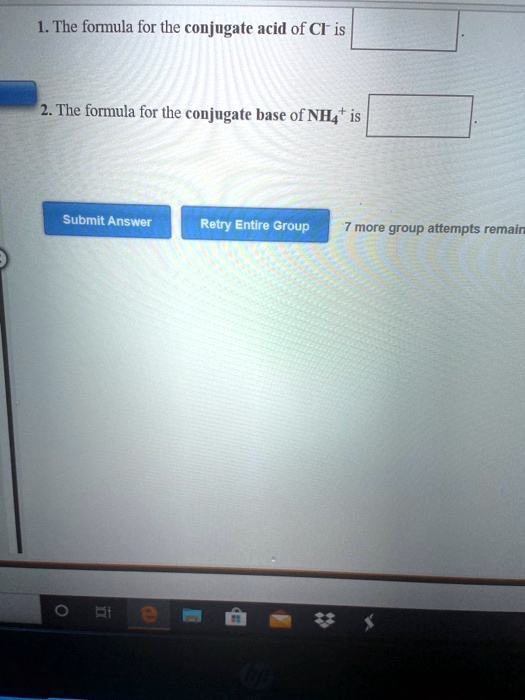
The formula for the conjugate acid of CL is 2. The formula for the conjugate base of ) NH Submit Answer Retry Entire Group more group attempts remair
The Correct Answer and Explanation is:
Here are the correct answers to the questions in the image:
- The formula for the conjugate acid of Cl⁻ is HCl.
- The formula for the conjugate base of NH₄⁺ is NH₃.
Explanation
These questions are based on the Brønsted-Lowry theory of acids and bases, which defines acids and bases in terms of proton (H⁺) transfer. According to this theory, an acid is a species that donates a proton, and a base is a species that accepts a proton.
When an acid and a base react, they form their corresponding conjugate base and conjugate acid. A conjugate acid-base pair consists of two substances that differ only by the presence or absence of a single proton (H⁺).
1. The Conjugate Acid of Cl⁻
To find the conjugate acid of a given substance, we must treat that substance as a base. A base accepts a proton. Therefore, to find the conjugate acid of the chloride ion (Cl⁻), we add a proton (H⁺) to its formula.
- Base: Cl⁻
- Add a proton: Cl⁻ + H⁺
- Resulting Conjugate Acid: HCl
When the negatively charged Cl⁻ ion accepts a positively charged H⁺ ion, the charges cancel out, resulting in the neutral molecule hydrochloric acid (HCl). Thus, HCl is the conjugate acid of Cl⁻.
2. The Conjugate Base of NH₄⁺
To find the conjugate base of a given substance, we must treat that substance as an acid. An acid donates a proton. Therefore, to find the conjugate base of the ammonium ion (NH₄⁺), we remove a proton (H⁺) from its formula.
- Acid: NH₄⁺
- Remove a proton: NH₄⁺ → ? + H⁺
- Resulting Conjugate Base: NH₃
When the positively charged ammonium ion (NH₄⁺) donates a proton, it loses one hydrogen atom and its positive charge. This leaves behind a neutral molecule with one nitrogen and three hydrogen atoms, which is ammonia (NH₃). Thus, NH₃ is the conjugate base of NH₄⁺.