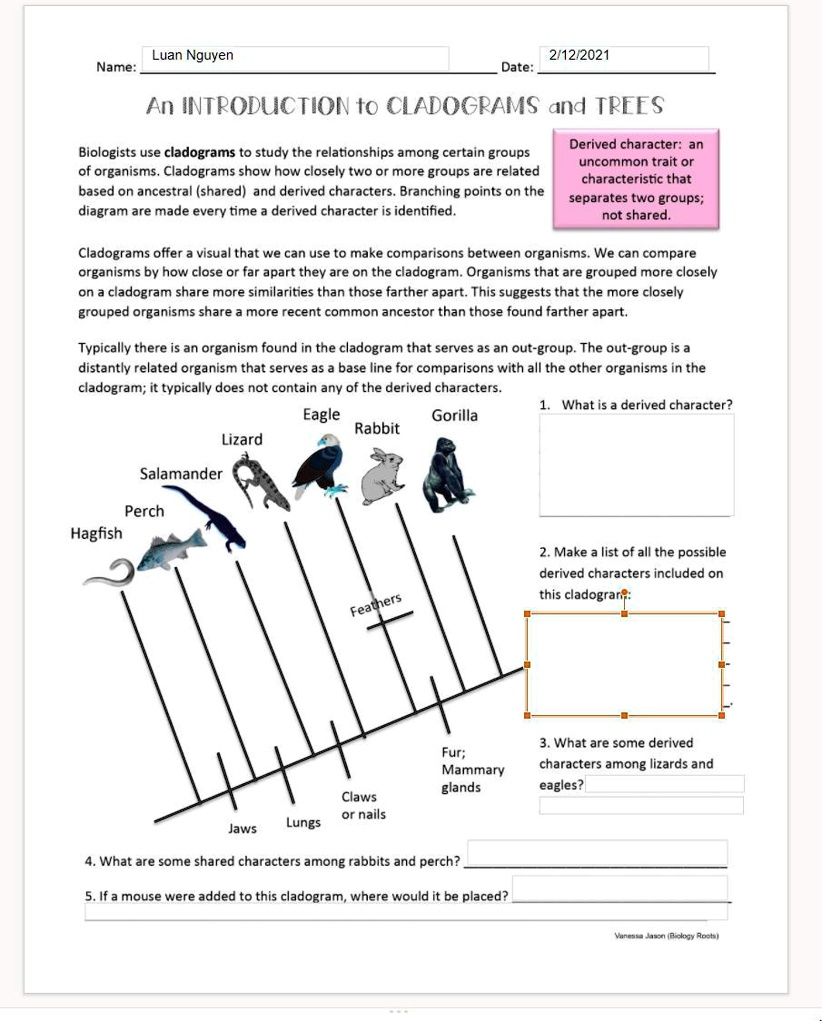
Luan Nguyen Name: 2/12/2021 Date: An INTRODUCTION to CLADOGRAMS and TREES Biologists use cladograms to study the relationships among certain groups of organisms. Cladograms show how closely two or more groups are related based on ancestral (shared) and derived characters. Branching points on the diagram are made every time a derived character is identified. Derived character: an uncommon trait or characteristic that separates two groups; not shared. Cladograms offer a visual that we can use to make comparisons between organisms. We can compare organisms by how close or far apart they are on the cladogram. Organisms that are grouped more closely on a cladogram share more similarities than those farther apart. This suggests that the more closely grouped organisms share a more recent common ancestor than those found farther apart. Typically there is an organism found in the cladogram that serves as an out-group. The out-group is a distantly related organism that serves as a base line for comparisons with all the other organisms in the cladogram; it typically does not contain any of the derived characters. Eagle Rabbit Gorilla 1. What is a derived character? Lizard Salamander Perch Hagfish Feathers 2. Make a list of all the possible derived characters included on this cladogram: Fur; Mammary glands 3. What are some derived characters among lizards and eagles? Claws or nails Lungs Jaws 4. What are some shared characters among rabbits and perch? 5. If a mouse were added to this cladogram, where would it be placed? Vanessa Jason (Biology Roots)
The Correct Answer and Explanation is:
Correct Answer:
A mouse would be placed on a new branch next to the rabbit and the gorilla, after the derived character “Fur; Mammary glands.”
Explanation:
A cladogram is a diagram that illustrates evolutionary relationships among organisms based on shared derived characters. To determine where a mouse would be placed, we must identify which derived characters shown on this cladogram a mouse possesses.
Following the cladogram from left to right, we encounter several derived characters. A mouse has jaws, so it would be placed to the right of the perch. A mouse also has lungs, placing it to the right of the salamander. Mice have claws, which means they belong on the branch after the “Claws or nails” characteristic, along with the lizard, eagle, rabbit, and gorilla.
The next branching point separates organisms based on having feathers versus having fur and mammary glands. An eagle has feathers, but a mouse does not. A mouse, being a mammal, has both fur and mammary glands. This places it on the same main branch as the rabbit and the gorilla, which are also mammals.
Therefore, a new line representing the mouse would branch off from the main lineage after the point where “Fur; Mammary glands” appears. It would be grouped with the rabbit and the gorilla, indicating that all three share a more recent common ancestor with each other than with any other animal on the cladogram. Placing the mouse in this position accurately reflects its status as a mammal, sharing key derived traits with other mammals like the rabbit and gorilla.