Calculate the derivative
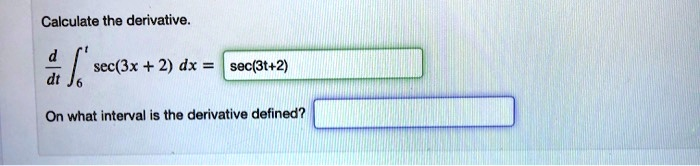
The Correct Answer and Explanation is:
Correct Answer
Derivative: sec(3t + 2)
Interval where the derivative is defined: (11π/6 – 2/3, 13π/6 – 2/3)
Explanation
This problem involves two related calculus concepts: applying the Fundamental Theorem of Calculus and determining the domain of the resulting function based on the constraints of the original integral.
First, we calculate the derivative d/dt ∫[from 6 to t] sec(3x + 2) dx. This expression is a classic application of the Fundamental Theorem of Calculus (FTC), Part 1. The theorem provides a powerful link between differentiation and integration, stating that if a function F is defined by F(t) = ∫[from a to t] f(x) dx, where f is a continuous function on an interval containing the constant ‘a’, then the derivative of F is simply F'(t) = f(t). For the given problem, the constant lower limit ‘a’ is 6, and the integrand is f(x) = sec(3x + 2). To find the derivative, we directly apply the FTC by replacing the integration variable ‘x’ with the upper limit ‘t’. This straightforward substitution yields the derivative: sec(3t + 2).
The second, more nuanced part is to determine the interval on which this derivative is defined. The existence of the derivative F'(t) is contingent upon the differentiability of the original function F(t). The FTC guarantees this differentiability only where the integrand f(x) = sec(3x + 2) is continuous. The integral itself is defined from a fixed point, x=6, to a variable point, t. For the integral to be well defined, there can be no discontinuities on the path of integration between 6 and t. This implies that t must belong to the same continuous interval as the point 6.
The function f(x) = sec(3x + 2), which is equivalent to 1/cos(3x + 2), has vertical asymptotes and is discontinuous wherever its denominator, cos(3x + 2), equals zero. This occurs when the argument 3x + 2 is an odd multiple of π/2, that is, 3x + 2 = (π/2) + nπ, for any integer n. Solving for x, we find the locations of the discontinuities are x = (π/6) + n(π/3) – 2/3. We need to identify the specific interval between two consecutive discontinuities that contains our lower limit of integration, x=6. By testing integer values for n, we find the discontinuities bracketing 6 are for n=5, giving x = 11π/6 – 2/3 (approximately 5.093), and for n=6, giving x = 13π/6 – 2/3 (approximately 6.140). Therefore, the largest open interval of continuity containing 6 is (11π/6 – 2/3, 13π/6 – 2/3). The derivative is defined for all t within this interval.