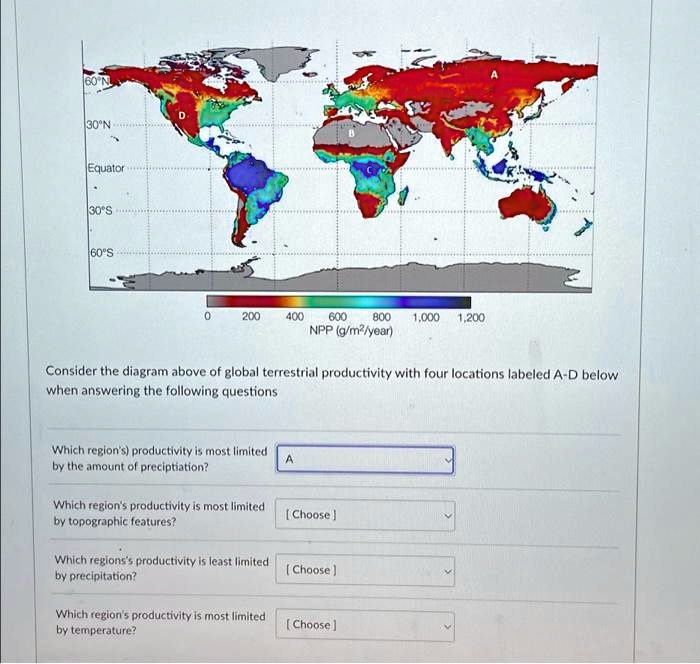
60°N 30°N Equator 30°S 60°S D 0 200 400 600 800 1,000 1,200 NPP (g/m²/year) A Consider the diagram above of global terrestrial productivity with four locations labeled A-D below when answering the following questions Which region’s) productivity is most limited by the amount of preciptiation? A Which region’s productivity is most limited by topographic features? [Choose] Which regions’s productivity is least limited by precipitation? [Choose] Which region’s productivity is most limited by temperature? [Choose]
The Correct Answer and Explanation is:
Here are the correct answers for the questions based on the provided diagram of global terrestrial productivity.
1. Which region’s productivity is most limited by the amount of precipitation?
B
2. Which region’s productivity is most limited by topographic features?
D
3. Which region’s productivity is least limited by precipitation?
C
4. Which region’s productivity is most limited by temperature?
A
Explanation
The provided map illustrates Net Primary Productivity (NPP), which is the rate at which plants produce biomass. The primary factors that limit terrestrial NPP are sunlight, temperature, water (precipitation), and nutrients.
1. Most Limited by Precipitation: Region B
Region B is located in North Africa and covers the Sahara Desert. The map shows this area has an NPP near zero, indicated by the grey and white colors. Deserts are, by definition, ecosystems characterized by extremely low rainfall. While temperatures are high, the primary factor preventing plant growth is the severe lack of water. Therefore, productivity in region B is most limited by precipitation.
2. Most Limited by Topographic Features: Region D
Region D is on the west coast of North America, an area known for mountain ranges like the Cascades that run parallel to the coast. This topography creates a strong “rain shadow” effect. Moist air from the Pacific Ocean is forced upward by the mountains, causing it to cool and release its moisture as heavy rain on the western (windward) side. This supports the high productivity (green and yellow) seen along the coast. As the dry air descends on the eastern (leeward) side, it creates arid conditions with much lower productivity. This sharp gradient in NPP, directly caused by the mountains, shows that topographic features are the most significant limiting factor in this region.
3. Least Limited by Precipitation: Region C
Region C is in the Congo Basin, an equatorial rainforest. The map shows this area has some of the highest NPP on Earth, indicated by the deep red color. Equatorial regions receive abundant and consistent rainfall throughout the year, meaning water is not a limiting factor for plant growth. In such environments, the limiting factors are more likely to be competition for sunlight under the dense canopy or the availability of soil nutrients.
4. Most Limited by Temperature: Region A
Region A is in the high latitudes of northern Asia, encompassing boreal forest and tundra biomes. These regions experience extremely long, cold winters with a very short growing season. Although water may be available from snowmelt during the brief summer, the low temperatures for most of the year are the primary constraint on plant growth and metabolism. This severely limits the annual NPP, making temperature the most significant limiting factor in this region.