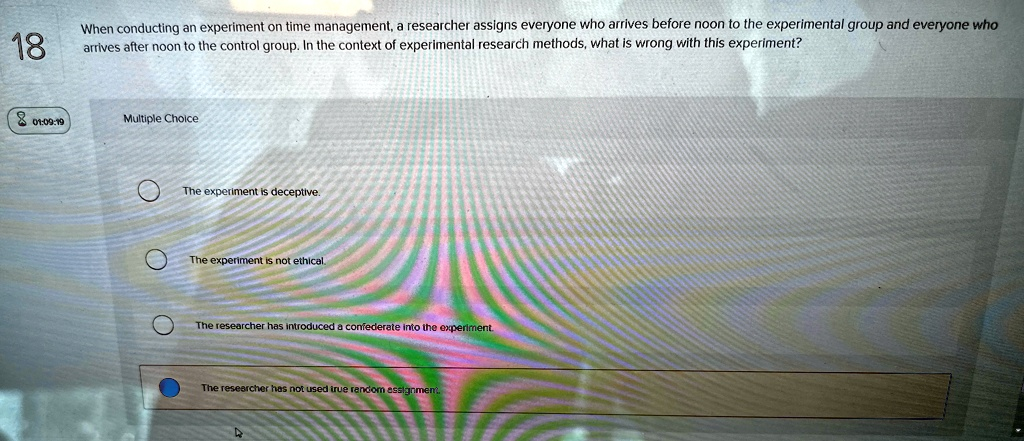
When conducting an experiment on time management, a researcher assigns everyone who arrives before noon to the experimental group and everyone who arrives after noon to the control group. In the context of experimental research methods, what is wrong with this experiment? Multiple Choice The experiment is deceptive. The experiment is not ethical. The researcher has introduced a confederate into the experiment. The researcher has not used true random assignment.
The Correct Answer and Explanation is:
Correct Answer: The researcher has not used true random assignment.
Explanation:
The fundamental flaw in this experimental design is the complete absence of random assignment. In a true experiment, random assignment is a critical procedure where each participant has an equal and independent chance of being placed into either the experimental group or the control group. The primary purpose of this process is to ensure that the groups are equivalent at the outset of the study, minimizing the influence of pre-existing differences between participants.
By assigning participants based on their arrival time, the researcher has created a systematic bias. This method, known as a convenience or quasi-experimental design, does not control for confounding variables. In this specific experiment on time management, the time a person arrives is likely correlated with the very trait being studied. People who arrive before noon may inherently possess better time management skills, be more conscientious, or have different work or sleep schedules compared to those who arrive after noon.
Consequently, the experimental group (early arrivers) and the control group (late arrivers) are not comparable from the start. If the experimental group shows better outcomes, the researcher cannot confidently conclude that the time management intervention was the cause. The observed difference could be entirely due to the pre-existing characteristics that led them to arrive early in the first place. This systematic difference between groups is a confounding variable that threatens the internal validity of the experiment, making it impossible to establish a clear cause-and-effect relationship between the intervention and the outcome. The other options are less likely; the experiment is not inherently deceptive or unethical, and there is no mention of a confederate. The core problem is a methodological failure to randomize.