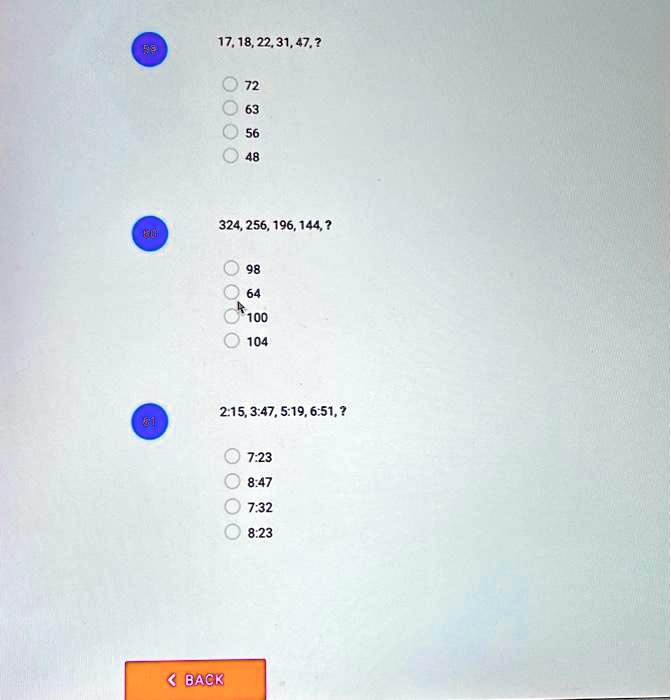
17, 18, 22, 31, 47,? 72 63 56 48 324, 256, 196, 144,? 98 64 100 104 2:15, 3:47, 5:19, 6:51, ? 7:23 8:47 7:32 8:23
The Correct Answer and Explanation is:
Here are the correct answers and explanations for the sequences presented in the image.
1. Sequence: 17, 18, 22, 31, 47, ?
Correct Answer: 72
Explanation: This sequence is solved by analyzing the difference between consecutive terms.
- 18 – 17 = 1
- 22 – 18 = 4
- 31 – 22 = 9
- 47 – 31 = 16
The differences form a new sequence: 1, 4, 9, 16. These numbers are the perfect squares of consecutive integers (1², 2², 3², 4²). The next difference in this pattern would be 5², which is 25. To find the next term in the original sequence, you add this difference to the last known term: 47 + 25 = 72.
2. Sequence: 324, 256, 196, 144, ?
Correct Answer: 100
Explanation: Each number in this sequence is a perfect square. To identify the pattern, we find the square root of each term.
- √324 = 18
- √256 = 16
- √196 = 14
- √144 = 12
The square roots form a simple arithmetic sequence (18, 16, 14, 12), where each number decreases by 2. The next number in this sequence of roots would be 10. To find the next term in the original sequence, we square this number: 10² = 100.
3. Sequence: 2:15, 3:47, 5:19, 6:51, ?
Correct Answer: 8:23
Explanation: This problem contains two interleaved sequences, one for the hours and one for the minutes.
- Hours sequence: 2, 3, 5, 6, ? We can split this into two sub-sequences: (2, 5, …) and (3, 6, …). Both sub-sequences follow a pattern of adding 3. The next term belongs to the first sub-sequence, so we calculate 5 + 3 = 8.
- Minutes sequence: 15, 47, 19, 51, ? This also splits into two interleaved sub-sequences: (15, 19, …) and (47, 51, …). Both of these sub-sequences follow a pattern of adding 4. The next term belongs to the first sub-sequence, so we calculate 19 + 4 = 23.
Combining the results for the hour and the minute gives the next term in the sequence: 8:23.