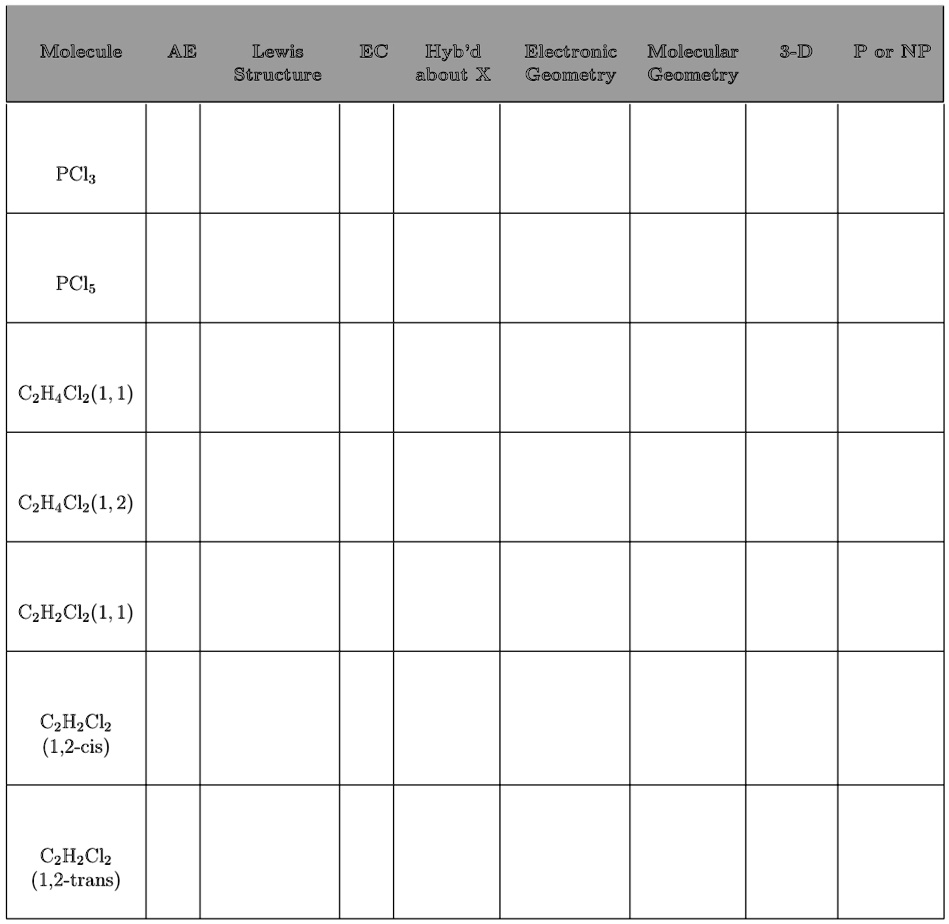
Molecule AE Lewis Structure EC Hyb’d about X Electronic Geometry Molecular Geometry 3-D P or NP PC13 PC15 C2H4Cl2(1, 1) C2H4Cl2(1, 2) C2H2Cl2(1,1) C2H2Cl2 (1,2-cis) C2H2Cl2 (1,2-trans)
The Correct Answer and Explanation is:
Of course. Here is the completed information for the chart, followed by an explanation of the concepts used.
Completed Chart Data
Row 1: PCl₃
- AE: 26
- Lewis Structure: Phosphorus is the central atom, single-bonded to three chlorine atoms. There is one lone pair of electrons on the phosphorus atom. Each chlorine has three lone pairs.
- EC (about P): 4 (3 bonds, 1 lone pair)
- Hyb’d about X (P): sp³
- Electronic Geometry: Tetrahedral
- Molecular Geometry: Trigonal Pyramidal
- 3-D: A pyramid shape with P at the apex and three Cl atoms forming the base. A lone pair occupies the fourth position of the tetrahedron.
- P or NP: P (Polar)
Row 2: PCl₅
- AE: 40
- Lewis Structure: Phosphorus is the central atom, single-bonded to five chlorine atoms, utilizing an expanded octet. Each chlorine has three lone pairs.
- EC (about P): 5 (5 bonds, 0 lone pairs)
- Hyb’d about X (P): sp³d
- Electronic Geometry: Trigonal Bipyramidal
- Molecular Geometry: Trigonal Bipyramidal
- 3-D: P is at the center, with three Cl atoms in a plane around the middle (equatorial) and two Cl atoms above and below this plane (axial).
- P or NP: NP (Nonpolar)
Row 3: C₂H₄Cl₂(1,1)
- AE: 26
- Lewis Structure: Two carbons are single-bonded. One carbon is bonded to one H and two Cl atoms. The second carbon is bonded to three H atoms.
- EC (about C): 4 (for both carbons)
- Hyb’d about X (C): sp³ (for both carbons)
- Electronic Geometry: Tetrahedral (around each carbon)
- Molecular Geometry: Tetrahedral (around each carbon)
- 3-D: Two linked tetrahedra. One tetrahedron has a central carbon with two Cl and one H. The other has a central carbon with three H.
- P or NP: P (Polar)
Row 4: C₂H₄Cl₂(1,2)
- AE: 26
- Lewis Structure: Two carbons are single-bonded. Each carbon is bonded to two H atoms and one Cl atom.
- EC (about C): 4 (for both carbons)
- Hyb’d about X (C): sp³ (for both carbons)
- Electronic Geometry: Tetrahedral (around each carbon)
- Molecular Geometry: Tetrahedral (around each carbon)
- 3-D: Two linked tetrahedra. Each central carbon has one Cl and two H. The molecule can rotate around the C-C bond.
- P or NP: P (Polar)
Row 5: C₂H₂Cl₂(1,1)
- AE: 24
- Lewis Structure: Two carbons are double-bonded. One carbon is bonded to two H atoms. The other carbon is bonded to two Cl atoms.
- EC (about C): 3 (for both carbons)
- Hyb’d about X (C): sp² (for both carbons)
- Electronic Geometry: Trigonal Planar (around each carbon)
- Molecular Geometry: Trigonal Planar (around each carbon)
- 3-D: A flat molecule. The two Cl atoms are on one side of the double bond, and the two H atoms are on the other.
- P or NP: P (Polar)
Row 6: C₂H₂Cl₂(1,2-cis)
- AE: 24
- Lewis Structure: Two carbons are double-bonded. Each carbon is bonded to one H and one Cl. The two Cl atoms are on the same side of the double bond.
- EC (about C): 3 (for both carbons)
- Hyb’d about X (C): sp² (for both carbons)
- Electronic Geometry: Trigonal Planar (around each carbon)
- Molecular Geometry: Trigonal Planar (around each carbon)
- 3-D: A flat molecule. The two Cl atoms are on one side (e.g., “top”) of the C=C bond, and the two H atoms are on the other (e.g., “bottom”).
- P or NP: P (Polar)
Row 7: C₂H₂Cl₂(1,2-trans)
- AE: 24
- Lewis Structure: Two carbons are double-bonded. Each carbon is bonded to one H and one Cl. The two Cl atoms are on opposite sides of the double bond.
- EC (about C): 3 (for both carbons)
- Hyb’d about X (C): sp² (for both carbons)
- Electronic Geometry: Trigonal Planar (around each carbon)
- Molecular Geometry: Trigonal Planar (around each carbon)
- 3-D: A flat molecule. One Cl is on the “top” of the C=C bond, and the other is on the “bottom,” creating a symmetrical arrangement.
- P or NP: NP (Nonpolar)
Explanation
This table analyzes molecular properties using Valence Shell Electron Pair Repulsion (VSEPR) theory. The first step for each molecule is calculating the total available valence electrons (AE) and drawing the Lewis structure. This structure reveals the number of electron domains (EC), which are the regions of electron density (bonds or lone pairs) around a central atom.
The number of electron domains determines both the electronic geometry and the central atom’s hybridization. For example, PCl₃ has four electron domains (three bonds, one lone pair), resulting in a tetrahedral electronic geometry and sp³ hybridization. Because one domain is a non-bonding lone pair, the molecular geometry, which describes only the arrangement of atoms, is trigonal pyramidal.
Molecular polarity depends on both bond polarity and molecular symmetry. A molecule with polar bonds (like P-Cl) can be nonpolar if its shape is symmetrical, causing the individual bond dipoles to cancel out. This is seen in PCl₅, which has a symmetrical trigonal bipyramidal shape and is nonpolar. In contrast, the trigonal pyramidal shape of PCl₃ is asymmetrical; its bond dipoles do not cancel, making the molecule polar.
This principle is also clear with the isomers of C₂H₂Cl₂. Both cis and trans isomers have polar C-Cl bonds and a planar shape due to sp² hybridization. However, in the cis isomer, both chlorine atoms are on the same side, creating a net dipole moment and making the molecule polar. In the trans isomer, the chlorine atoms are on opposite sides. Their equal and opposite bond dipoles cancel each other perfectly, rendering the molecule nonpolar.