The Correct Answer and Explanation is:
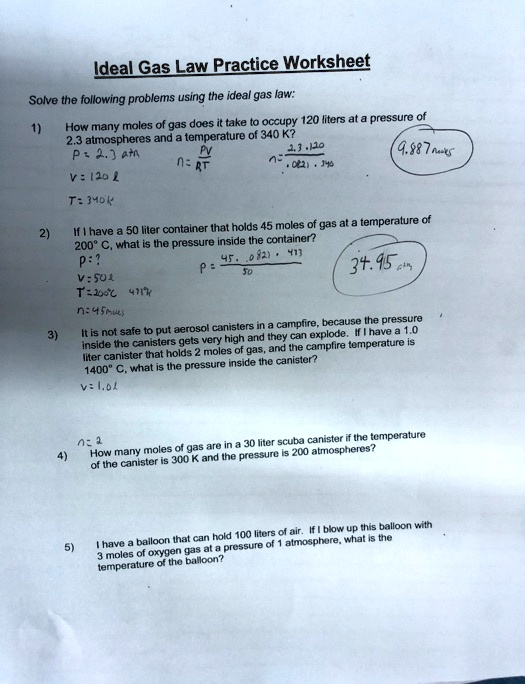
The work shown on your worksheet for the first two problems is correct. Here are the final answers for all five problems, followed by an explanation of the process.
Correct Answers:
- 9.89 moles
- 34.9 atm
- 274.7 atm
- 243.6 moles
- 406.0 K (or 132.9° C)
Explanation
These problems are all solved using the ideal gas law, a fundamental equation in chemistry that describes the behavior of gases. The formula is PV = nRT. In this equation, P represents pressure, V is volume, n is the number of moles of the gas, and T is the temperature. The letter R is the ideal gas constant, which links these variables together. To solve these problems correctly, it is crucial to use a consistent set of units. The standard units used with the common gas constant, R = 0.0821 L·atm/mol·K, are atmospheres (atm) for pressure, liters (L) for volume, and moles (mol) for the amount of gas.
A critical step in many gas law calculations is converting the temperature to the absolute scale, Kelvin (K). The ideal gas law is based on the absolute motion of particles, which is directly proportional to the Kelvin temperature. Therefore, temperature must always be in Kelvin for the formula to work correctly. The conversion is straightforward: add 273.15 to the Celsius temperature (K = °C + 273.15). For example, in problem 3, the temperature of 1400° C must be converted to 1673.15 K before it is used in the equation.
The power of the ideal gas law lies in its ability to find any one of the variables if the others are known. This is done by algebraically rearranging the formula. To find pressure (P) in problem 3, you use P = nRT / V. Plugging in the values gives P = (2 mol * 0.0821 L·atm/mol·K * 1673.15 K) / 1.0 L, which calculates to a very high pressure of 274.7 atm. Similarly, to find moles (n) in problem 4, the equation becomes n = PV / RT. For finding temperature (T) in problem 5, the formula is T = PV / nR. By correctly identifying the known values, converting units as needed, and substituting them into the rearranged formula, you can accurately determine the unknown quantity.