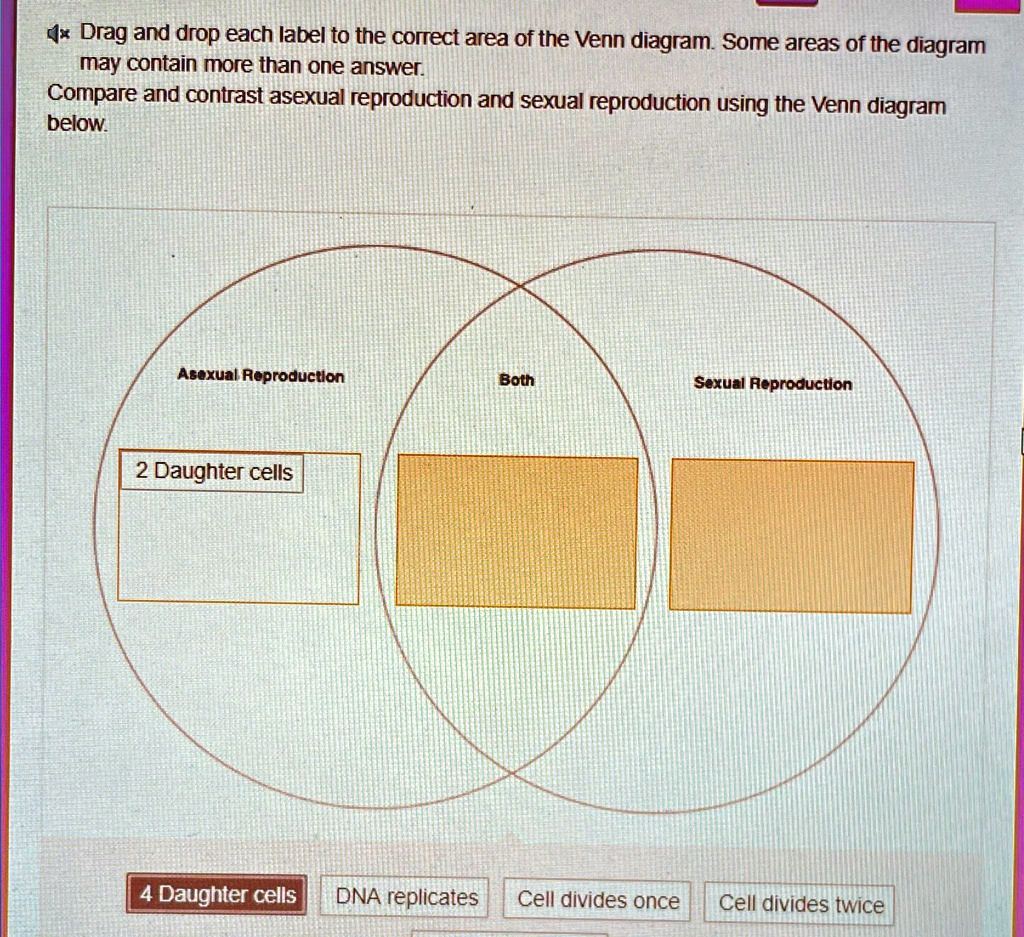
Drag and drop each label to the correct area of the Venn diagram. Some areas of the diagram may contain more than one answer. Compare and contrast asexual reproduction and sexual reproduction using the Venn diagram below. Asexual Reproduction Both Sexual Reproduction 2 Daughter cells 4 Daughter cells DNA replicates Cell divides once Cell divides twice
The Correct Answer and Explanation is:
Here is the correct placement for each label in the Venn diagram:
Asexual Reproduction:
- 2 Daughter cells
- Cell divides once
Both:
- DNA replicates
Sexual Reproduction:
- 4 Daughter cells
- Cell divides twice
Explanation
This Venn diagram compares the cellular processes that underlie asexual and sexual reproduction, specifically focusing on mitosis for asexual reproduction and meiosis for sexual reproduction.
Asexual Reproduction
The characteristics placed in this section are unique to the process of mitosis, which is the basis for asexual reproduction in many organisms.
- Cell divides once: In mitosis, a parent cell undergoes a single round of division. This process includes prophase, metaphase, anaphase, and telophase, followed by cytokinesis, resulting in a single, complete division.
- 2 Daughter cells: The outcome of this single division is the creation of two daughter cells. These cells are diploid, meaning they have the same number of chromosomes as the parent cell, and are genetically identical to both the parent cell and each other. This ensures the stable inheritance of traits from one generation to the next without genetic variation.
Sexual Reproduction
The labels in this category are distinct features of meiosis, the specialized cell division that produces gametes (like sperm and egg cells) for sexual reproduction.
- Cell divides twice: Meiosis is a more complex process involving two consecutive rounds of cell division, known as Meiosis I and Meiosis II. This double division is necessary to reduce the chromosome number by half.
- 4 Daughter cells: Because the cell divides twice, the process results in four daughter cells. These cells are haploid, containing half the number of chromosomes as the original parent cell. Furthermore, due to processes like crossing over and independent assortment, these four cells are genetically unique, which is a key source of genetic variation in sexually reproducing populations.
Both
The characteristic placed in the overlapping central section is a fundamental requirement for both types of cell division.
- DNA replicates: Before any cell can divide, whether through mitosis or meiosis, it must first duplicate its genetic material. This process, called DNA replication, occurs during the S phase of interphase. It ensures that each daughter cell will receive a complete and correct set of DNA. Without DNA replication, the amount of genetic information would be halved with each division, which would not be sustainable for life. Therefore, this crucial preparatory step is common to both asexual and sexual reproduction pathways.