ionic compound
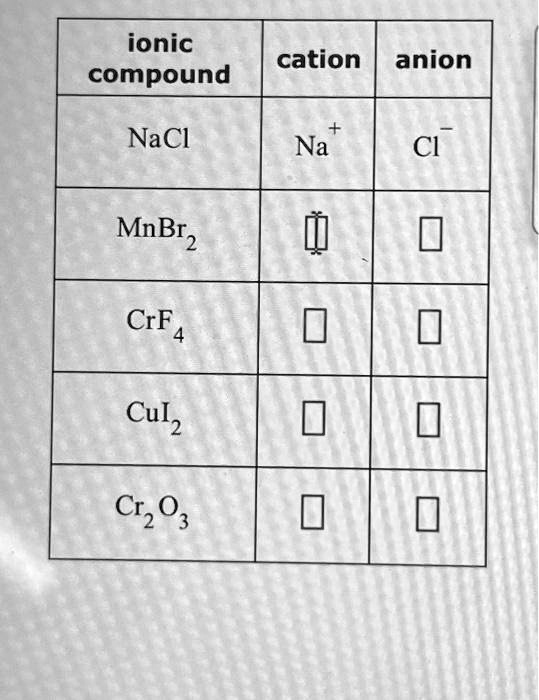
The Correct Answer and Explanation is:
Here is the completed table with the correct cations and anions for each ionic compound.
| ionic compound | cation | anion |
| NaCl | Na⁺ | Cl⁻ |
| MnBr₂ | Mn²⁺ | Br⁻ |
| CrF₄ | Cr⁴⁺ | F⁻ |
| CuI₂ | Cu²⁺ | I⁻ |
| Cr₂O₃ | Cr³⁺ | O²⁻ |
Explanation
This table requires identifying the individual cations (positive ions) and anions (negative ions) that combine to form a neutral ionic compound. The fundamental principle governing ionic compounds is that the total positive charge from all the cations must perfectly balance the total negative charge from all the anions, resulting in an overall charge of zero.
The first row, sodium chloride (NaCl), is provided as an example. Sodium (Na), a Group 1 metal, forms a +1 cation (Na⁺), and chlorine (Cl), a Group 17 halogen, forms a -1 anion (Cl⁻). The +1 and -1 charges balance, creating a neutral compound.
For manganese(II) bromide (MnBr₂), the anion is bromide. Bromine (Br) is a halogen and consistently forms a -1 ion (Br⁻). The subscript 2 indicates there are two bromide ions, for a total negative charge of 2 × (-1) = -2. To balance this, the single manganese (Mn) cation must have a charge of +2, making it Mn²⁺.
In chromium(IV) fluoride (CrF₄), the anion is fluoride. Fluorine (F) is the most electronegative element and always forms a -1 ion (F⁻). With four fluoride ions, the total negative charge is 4 × (-1) = -4. The single chromium (Cr) atom must therefore carry a +4 charge to neutralize the compound, resulting in the Cr⁴⁺ cation.
For copper(II) iodide (CuI₂), the anion is iodide. Iodine (I), like other halogens, forms a -1 ion (I⁻). The two iodide ions create a total negative charge of 2 × (-1) = -2. Consequently, the copper (Cu) cation must have a +2 charge to achieve neutrality, making it Cu²⁺.
Finally, in chromium(III) oxide (Cr₂O₃), the anion is oxide. Oxygen (O), from Group 16, typically forms a -2 ion (O²⁻). The subscript 3 indicates three oxide ions, giving a total negative charge of 3 × (-2) = -6. The compound contains two chromium atoms, which together must provide a total positive charge of +6 to balance the -6. Therefore, each chromium cation must have a charge of +6 ÷ 2 = +3, making the cation Cr³⁺.