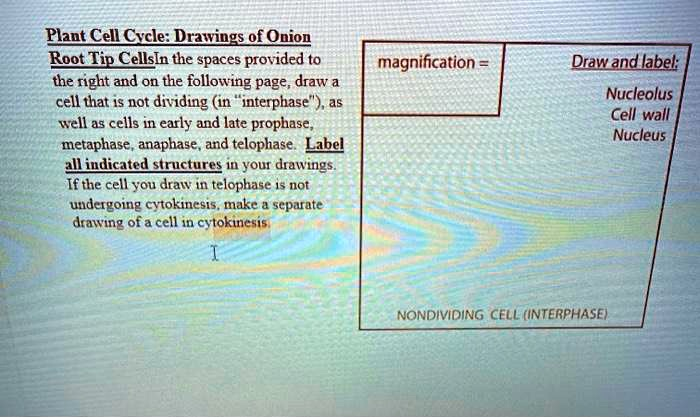
Plant Cell Cycle: Drawings of Onion Root Tip Cells In the spaces provided to the right and on the following page, draw cells that are not dividing (in interphase), as well as cells in early and late prophase, metaphase, anaphase, and telophase. Label the indicated structures in your drawings. If the cell you draw in telophase is not undergoing cytokinesis, make a separate drawing of a cell in cytokinesis. Magnification: Draw and label: Nucleolus, Cell wall, Nucleus NONDIVIDING CELL (INTERPHASE)
The Correct Answer and Explanation is:
Correct Answer
For the “NONDIVIDING CELL (INTERPHASE)” section, the correct drawing would show a rectangular plant cell with a thick outer cell wall. Inside the cell wall, a large, distinct, and circular nucleus should be drawn. Within this nucleus, a smaller, dark, and dense circle representing the nucleolus must be included. The genetic material inside the nucleus should be depicted as diffuse and grainy chromatin, not as distinct, condensed chromosomes. Lines should be drawn from each of these three structures (cell wall, nucleus, nucleolus) to their respective labels. A typical magnification to be written in the box would be 400x.
Explanation
Interphase is the longest stage of the plant cell cycle, during which the cell grows, carries out its normal metabolic functions, and prepares for division. Although it is described as a “nondividing” state, it is a period of intense cellular activity. A drawing of an onion root tip cell in interphase should accurately reflect this preparatory stage.
The most prominent feature is the large, well-defined nucleus, which is fully intact and enclosed by its nuclear envelope. The nucleus houses the cell’s genetic material. During interphase, the DNA is in a relaxed, uncoiled form called chromatin. This is why, under a microscope, the nucleus appears granular or grainy instead of showing the distinct, rod-shaped chromosomes that characterize the later stages of mitosis. This diffuse appearance of chromatin is a key identifier for an interphase cell.
Inside the nucleus, the nucleolus should be clearly visible as a dense, dark spot. The nucleolus is essential for producing ribosomes, which are vital for protein synthesis needed for cell growth. The presence of a prominent nucleolus is a characteristic feature of interphase; it typically disassembles during prophase and reforms during telophase.
Surrounding the entire cell is the rigid cell wall, a structure unique to plant cells. It provides structural support and protection, giving the onion cell its characteristic rectangular or box-like shape. When drawing, the cell wall should be shown as the thickest, outermost layer. Together, the distinct nucleus with its visible nucleolus and the surrounding rigid cell wall create the classic image of a plant cell in interphase, a state of readiness for the dramatic events of cell division.