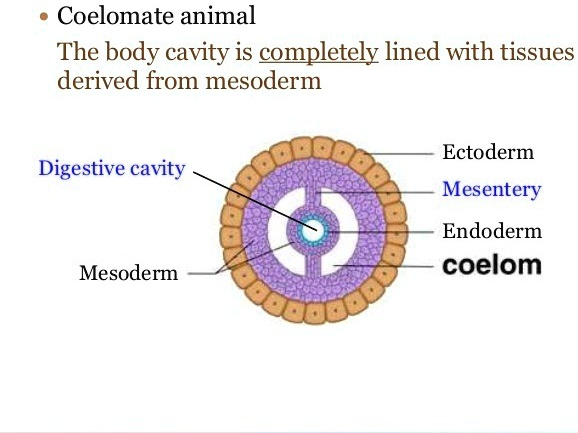
Coelomate animal The body cavity is completely lined with tissues derived from mesoderm Digestive cavity Mesoderm Ectoderm Mesentery Endoderm coelom
The Correct Answer and Explanation is:
Correct Answer: A diagram illustrating the body plan of a coelomate animal.
Explanation:
The image provided is a biological diagram that shows a cross-section of an animal with a coelomate body plan. This type of illustration is fundamental in developmental biology and zoology for classifying animals based on their internal body structure. The diagram is composed of three primary germ layers, which are distinct layers of cells formed during embryonic development.
The outermost layer, labeled as the ectoderm and colored orange, is responsible for forming the animal’s external covering, such as the skin, as well as the nervous system.
Interior to the ectoderm is the mesoderm, the middle layer shown in purple. In a coelomate, the mesoderm is the defining feature. It splits to form a fluid filled body cavity known as the coelom. This means the coelom is completely lined on all sides by tissue derived from the mesoderm. The outer portion of the mesoderm lines the body wall, while the inner portion covers the digestive tract. This complete mesodermal lining is what distinguishes a true coelomate from other body plans like pseudocoelomates or acoelomates. The diagram also points out the mesentery, which is a fold of mesodermal tissue that suspends the internal organs within the coelom, holding them in place.
The innermost layer is the endoderm, colored blue, which forms the lining of the digestive cavity, also known as the gut or archenteron. This cavity is where food is processed.
In essence, the image visually defines a coelomate animal as one possessing a true body cavity, the coelom, which is fully enclosed by the mesoderm. This anatomical arrangement allows for greater organ development, protection, and overall body complexity, representing a significant evolutionary advancement in the animal kingdom.