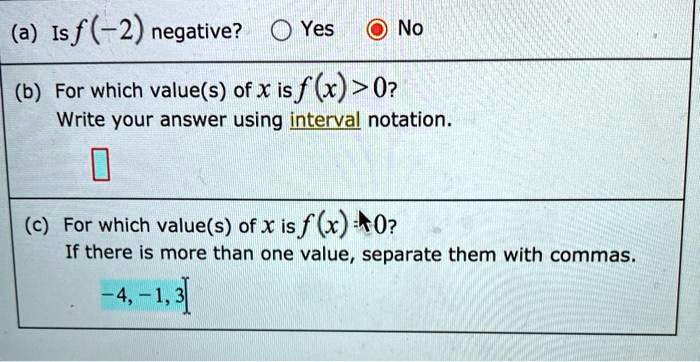
The Correct Answer and Explanation is:
The correct answer for part (b) is:
(-4, -1) U (3, ∞)
Explanation
To find the values of x for which f(x) > 0, we need to determine the intervals where the function’s graph lies above the x-axis. We can deduce this by using the information provided in parts (a) and (c).
First, let’s look at part (c). It tells us that f(x) = 0 for the x-values -4, -1, and 3. These are the roots, or x-intercepts, of the function. These are the points where the function’s value is neither positive nor negative. These roots divide the number line into four intervals: (-∞, -4), (-4, -1), (-1, 3), and (3, ∞). Within each of these intervals, the sign of f(x) will be consistent, meaning it will be either entirely positive or entirely negative.
Next, we use the clue from part (a), which states that f(-2) is not negative. Since x = -2 is not one of the roots, f(-2) cannot be zero. This means f(-2) must be positive. The input value x = -2 is located within the interval (-4, -1). Because we have found a point in this interval where the function is positive, we can conclude that f(x) is positive for the entire interval (-4, -1).
Assuming the function is a continuous polynomial-like curve that crosses the x-axis at each root, the sign of the function will alternate between adjacent intervals. Since the function is positive on (-4, -1), it must be negative on the interval to its right, (-1, 3). Following this alternating pattern, the function must be positive again on the next interval, (3, ∞). Similarly, it must have been negative on the interval to the left of (-4, -1), which is (-∞, -4).
Therefore, the function f(x) is positive, or f(x) > 0, on the intervals (-4, -1) and (3, ∞). The question asks for the answer in interval notation, so we combine these two intervals using the union symbol (U).