The Correct Answer and Explanation is:
Of course. Here is the correct answer and a detailed explanation.
Correct Answer
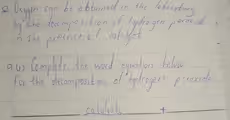
Hydrogen peroxide → Water + Oxygen
Explanation
The complete word equation for the decomposition of hydrogen peroxide is: Hydrogen peroxide gives Water plus Oxygen. This chemical process is a fundamental example of a decomposition reaction, where a single, more complex compound breaks down into two or more simpler, more stable substances.
Hydrogen peroxide, with the chemical formula H₂O₂, is an inherently unstable molecule. Its instability stems from the weak single bond between its two oxygen atoms, known as a peroxide bond. Due to this weak bond, hydrogen peroxide naturally decomposes into water (H₂O) and oxygen gas (O₂), which are significantly more stable compounds. However, this process occurs very slowly on its own at room temperature.
To make the reaction useful for applications like producing oxygen in a laboratory, a catalyst is introduced. A catalyst is a substance that dramatically increases the rate of a chemical reaction without being consumed or chemically altered by the end of the process. It achieves this by providing an alternative reaction pathway that requires less energy, known as a lower activation energy. In the word equation, the catalyst’s name is written above the arrow to show it facilitates the reaction but is neither a reactant nor a product.
A very common and effective catalyst for this reaction is manganese(IV) oxide (MnO₂), a black powder. When a small amount of manganese(IV) oxide is added to a solution of hydrogen peroxide, it immediately begins to fizz vigorously. This fizzing, or effervescence, is the rapid release of oxygen gas. Other substances can also act as catalysts, including potassium iodide and the enzyme catalase, which is found in many living things, including potatoes and blood. This catalyzed decomposition is a safe, reliable, and convenient method for generating pure oxygen gas in a controlled laboratory setting.