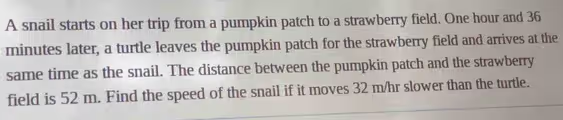
The Correct Answer and Explanation is:
The correct answer is that the speed of the snail is 20 m/hr.
To solve this problem, we need to establish a relationship between the speed, distance, and time for both the snail and the turtle. The distance for both is a constant 52 meters. The key is to relate their travel times and their speeds using algebraic equations.
First, let’s define our variables. Let v_s be the speed of the snail and v_t be the speed of the turtle. Let t_s be the time the snail takes and t_t be the time the turtle takes. The units for speed will be meters per hour (m/hr) and for time will be hours (hr).
The problem states that the snail moves 32 m/hr slower than the turtle. This gives us our first equation:
v_s = v_t – 32, which can be rewritten as v_t = v_s + 32.
Next, we address the time difference. The turtle leaves 1 hour and 36 minutes after the snail. We must convert this time entirely into hours for consistency. Since there are 60 minutes in an hour, 36 minutes is equal to 36/60, or 0.6 hours. Therefore, the total time difference is 1.6 hours. Because the snail starts earlier and they arrive at the same time, the snail travels for 1.6 hours longer than the turtle. This gives our second equation:
t_s = t_t + 1.6.
Using the fundamental relationship time = distance / speed, we can express the travel times in terms of speed:
t_s = 52 / v_s
t_t = 52 / v_t
Now we can substitute these expressions into our time equation:
52 / v_s = (52 / v_t) + 1.6
To solve for the snail’s speed, we substitute v_t = v_s + 32 into this equation, resulting in an equation with only one variable, v_s:
52 / v_s = (52 / (v_s + 32)) + 1.6
Solving this equation leads to a quadratic equation: 1.6v_s² + 51.2v_s – 1664 = 0. Factoring this equation or using the quadratic formula gives two possible solutions for v_s: 20 and -52. Since speed cannot be negative, the only physically possible answer is 20 m/hr.