The Correct Answer and Explanation is:
Here are the solutions to the questions presented in the image.
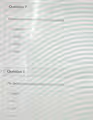
Question 7
Correct Answer: 47.9%
Explanation:
To express a decimal number as a percentage, the fundamental process involves multiplying the decimal by 100 and then appending the percent symbol (%). The term “percent” originates from the Latin phrase “per centum,” which literally means “per one hundred.” Therefore, when we convert a number to a percentage, we are essentially rephrasing it to represent how many parts it constitutes out of a total of one hundred.
In this specific problem, we are asked to convert the decimal 0.479 into a percentage. Following the conversion rule, we perform the calculation:
0.479 × 100 = 47.9
A simple way to visualize multiplying by 100 is to shift the decimal point two places to the right. Starting with 0.479, moving the decimal point one place gives 4.79, and moving it a second place gives 47.9.
After performing the multiplication, we add the percent sign to complete the conversion. This gives us the final answer of 47.9%.
Let’s review the provided options to understand why the others are incorrect. The first option, 0.00479%, would be the result of dividing the decimal by 100, which is the procedure for converting a percentage back into a decimal. The second option, 0.479%, incorrectly just adds the percent symbol without performing the necessary multiplication by 100. The fourth option, 479%, would be the correct percentage for the decimal 4.79, not 0.479. Thus, based on the correct mathematical procedure, 47.9% is the accurate representation of the decimal 0.479 as a percentage.
Question 8
Correct Answer: 0.875
Explanation:
To find the decimal equivalent of a fraction, you must perform the division that the fraction represents. A fraction is a way of expressing a division problem, where the numerator (the top number) is divided by the denominator (the bottom number). For the fraction 7/8, this means we need to calculate 7 divided by 8.
We can solve this using long division. Since 8 is larger than 7, we know the result will be less than 1. We start by placing a decimal point after the 7 and adding zeros as needed.
- Begin by dividing 7 by 8. It doesn’t go in, so we write a 0 followed by a decimal point in our answer.
- We then consider 7.0, or 70. How many times does 8 go into 70? The answer is 8 times, because 8 × 8 = 64. We write “8” after the decimal point in our answer.
- Subtract 64 from 70, which leaves a remainder of 6.
- Bring down another zero to make the new number 60. How many times does 8 go into 60? The answer is 7 times, because 8 × 7 = 56. We write “7” as the next digit in our answer.
- Subtract 56 from 60, which leaves a remainder of 4.
- Bring down one more zero to make the number 40. How many times does 8 go into 40? It goes in exactly 5 times, because 8 × 5 = 40. We write “5” as the final digit.
- The remainder is now 0, so the division is complete.
The result of the division is 0.875. This is the decimal equivalent of the fraction 7/8. Checking the options, 0.875 is the third choice. The other options are incorrect: 0.75 is the decimal for 3/4, and 8.75 is greater than 1, which is impossible for a proper fraction like 7/8.
