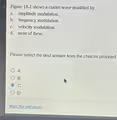
The Correct Answer and Explanation is:
Based on the selected option, the correct answer is c. velocity modulation.
Velocity modulation is a process fundamentally different from the more common amplitude modulation (AM) or frequency modulation (FM) used in radio broadcasting. Instead of altering a property of a carrier wave directly, velocity modulation involves changing the speed of charge carriers, typically electrons, within a beam.
This technique is most famously used in microwave tubes like the klystron. In a klystron, a beam of electrons traveling at a constant speed is passed through a cavity called a “buncher.” An input signal, which is the information to be amplified, creates a rapidly alternating electric field within this buncher cavity. As electrons pass through, their velocity is modulated. Electrons passing through when the field is accelerating are sped up, while those passing through when the field is decelerating are slowed down.
This initial change in velocity does not immediately create a usable signal. However, as the electron beam continues to travel down a drift tube, the faster electrons begin to catch up to the slower electrons that were ahead of them. This causes the electrons to group together into “bunches.” This transformation from velocity modulation to density modulation, where the electron beam now has periodic regions of high and low density, is the key to the process. These dense bunches of electrons can then pass through a second “catcher” cavity and induce a powerful, amplified electromagnetic wave.
In contrast, amplitude modulation varies the amplitude, or signal strength, of a carrier wave, and frequency modulation varies its frequency. Velocity modulation is a specialized technique for generating or amplifying very high frequency, high power signals in devices like radar and particle accelerators.