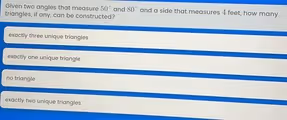
The Correct Answer and Explanation is:
The correct answer is exactly two unique triangles.
Here is the explanation:
To determine the number of possible triangles, we first need to find the measure of the third angle. The sum of the interior angles of any triangle is always 180 degrees. With two angles given as 50 degrees and 80 degrees, we can calculate the third angle as follows:
180° – (50° + 80°) = 180° – 130° = 50°
The three angles of the triangle are 50°, 80°, and 50°. Since two of the angles are equal, the triangle is an isosceles triangle. This means that the sides opposite the equal angles are also equal in length. Therefore, the triangle has two sides of one length and a third side of a different length.
The problem states that a side measures 4 feet, but it does not specify which side this is. This ambiguity leads to two separate and unique possibilities for the triangle’s construction.
Possibility 1: The 4-foot side is one of the two equal sides. In this case, the two sides opposite the 50° angles are each 4 feet long. The third side, which is opposite the 80° angle, would have a different, specific length. This configuration creates one unique, valid triangle.
Possibility 2: The 4-foot side is the unique, non-equal side. This would be the side opposite the 80° angle. In this case, the base of the isosceles triangle is 4 feet long. The two equal sides opposite the 50° angles would each have a length that is different from 4 feet. This configuration creates a second unique, valid triangle.
Because these two possibilities result in triangles that have different side lengths, they are not congruent. They are two distinct triangles. Therefore, exactly two unique triangles can be constructed with the given angles and side length.