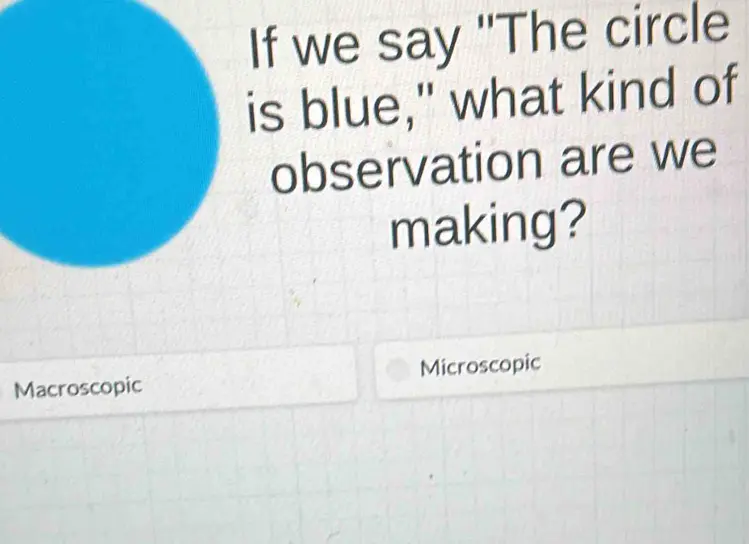
If we say “The circle is blue,” what kind of observation are we making?
Macroscopic
Microscopic
The correct answer and explanation is:
The correct answer is Macroscopic.
Explanation:
When we say “The circle is blue,” we are making a macroscopic observation. This type of observation involves perceiving and describing objects or phenomena that are visible to the naked eye without the need for magnification. In this case, the statement refers to the color of a circle, which is a property that can be observed directly without the aid of a microscope or other tools.
A macroscopic observation generally deals with the physical properties of objects at a scale that is visible and measurable with the unaided human eye. Examples of macroscopic observations include noting that a rock is rough, a tree is tall, or a liquid is clear.
On the other hand, microscopic observations involve studying objects or phenomena at a scale smaller than what the naked eye can see. These observations typically require magnification, such as using a microscope, to examine the details of small structures, like the cells in a piece of tissue or the surface of a material at a microscopic level. For instance, if you were to study the molecules or atoms that make up the color of the circle, or the fine details of its surface, you would be making a microscopic observation.
In summary, saying “The circle is blue” is an example of a macroscopic observation because it describes the color of an object in a way that is directly observable without any special instruments.