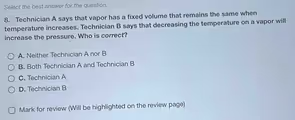
The Correct Answer and Explanation is:
A. Neither Technician A nor B
The correct answer is A because both technicians make statements that are inconsistent with the fundamental principles of gas behavior. Let’s break down why each statement is incorrect.
Analysis of Technician A’s Statement
Technician A claims that vapor has a fixed volume that remains the same when the temperature increases. This is fundamentally wrong. A key characteristic of gases and vapors is that they have neither a fixed shape nor a fixed volume. A vapor will always expand to fill the entire volume of its container. This property distinguishes gases from liquids, which have a fixed volume, and solids, which have both a fixed volume and a fixed shape.
While it is possible to hold a vapor in a rigid container with a fixed volume, the volume is determined by the container, not by an inherent property of the vapor itself. Furthermore, if the temperature of a gas increases in a non rigid container, its volume would increase according to Charles’s Law. Technician A’s statement misrepresents a core property of the gaseous state of matter.
Analysis of Technician B’s Statement
Technician B claims that decreasing the temperature of a vapor will increase its pressure. This statement is also incorrect and describes the opposite of what actually happens. The relationship between pressure and temperature of a gas in a constant volume is described by Gay-Lussac’s Law. This law states that pressure and absolute temperature are directly proportional.
This means that as the temperature of a gas decreases, its molecules move more slowly. This reduced kinetic energy results in fewer and less forceful collisions with the walls of the container, leading to a decrease in pressure. Conversely, increasing the temperature would increase the molecular motion and thus increase the pressure. A practical example is the pressure in a car’s tires, which is lower on a cold day than on a hot day. Technician B’s statement incorrectly reverses this direct relationship.
Since both technicians describe physical behaviors that are contrary to established gas laws, neither one is correct.