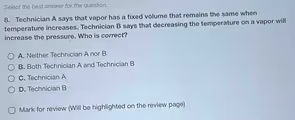
The Correct Answer and Explanation is:
The correct answer is A. Neither Technician A nor B.
Here is a detailed explanation of why both technicians are incorrect.
Analysis of Technician A’s Statement
Technician A claims that vapor has a fixed volume that remains the same when temperature increases. This statement is fundamentally incorrect. One of the defining properties of a substance in the gaseous state, such as a vapor, is that it has neither a fixed volume nor a fixed shape. A vapor will always expand to fill the entire volume of whatever container it occupies. The concept of a fixed volume applies to liquids and solids, but not to gases.
Furthermore, the relationship between the temperature and volume of a gas is described by the gas laws, specifically Charles’s Law. This law states that at a constant pressure, the volume of a gas is directly proportional to its absolute temperature. This means that if the temperature of a vapor increases, its molecules gain kinetic energy, move faster, and spread farther apart. Consequently, the volume of the vapor will increase, assuming it is in a flexible container or a system where pressure is kept constant. Therefore, Technician A’s statement is scientifically inaccurate.
Analysis of Technician B’s Statement
Technician B claims that decreasing the temperature of a vapor will increase its pressure. This statement is also incorrect. The relationship between the temperature and pressure of a gas at a constant volume is described by Gay-Lussac’s Law. This law states that the pressure of a gas is directly proportional to its absolute temperature.
This means that if you decrease the temperature of a vapor, its pressure will also decrease. Temperature is a measure of the average kinetic energy of the molecules. When the temperature is lowered, the molecules slow down. These slower-moving molecules will collide with the walls of their container less frequently and with less force. This reduction in the rate and force of collisions results in a decrease in pressure. Technician B’s statement describes the opposite of this established physical principle.
Since both technicians have made statements that contradict the known laws of gas behavior, neither of them is correct.