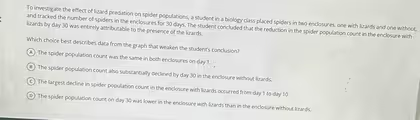
The Correct Answer and Explanation is:
The correct answer is B. The spider population count also substantially declined by day 30 in the enclosure without lizards.
Here is an explanation:
The student’s conclusion is that the reduction in the spider population was “entirely attributable” to the presence of lizards. This is a very strong claim, suggesting that lizard predation was the single, exclusive cause for the decline. To weaken this conclusion, we need to find evidence that points to another possible cause for the spider population’s decrease.
The experiment includes a control group, which is the enclosure without lizards. The purpose of a control group is to provide a baseline for comparison. It shows what would happen to the spider population under the same experimental conditions, but without the variable being tested, in this case, the lizards.
If the spider population in the enclosure without lizards also declined substantially, as stated in option B, it indicates that another factor was affecting the spiders. This unseen factor could be a limited food supply for the spiders, a disease, or other environmental stressors within the enclosures themselves. Since this factor caused a decline in the control group, it is logical to assume it also contributed to the decline in the experimental group (the one with lizards).
Therefore, the total reduction in the spider population in the lizard enclosure would be a combined result of lizard predation and this other environmental factor. This directly contradicts the student’s assertion that the decline was entirely due to the lizards.
The other options do not weaken the conclusion. Option A describes a proper experimental setup. Option C just details when the predation was most intense, which does not challenge the cause. Option D actually supports the student’s general hypothesis that lizards reduce spider populations, rather than weakening it.