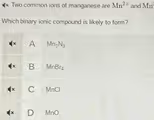
The Correct Answer and Explanation is:
Expand to view model thoughtschevron_right
The correct answer is D. MnO.
The formation of a stable binary ionic compound relies on the principle of charge neutrality. This means the total positive charge from the metal cation must perfectly balance the total negative charge from the nonmetal anion. The problem states that the two common ions of manganese (Mn) are Mn²⁺ and Mn³⁺. We must evaluate each option to see which chemical formula results in a neutral compound using one of these manganese ions.
To do this, we first determine the typical charge of the nonmetal anion in each proposed compound.
- In option A, Mn₂N₃, nitrogen (N) is in Group 15 and typically forms the nitride ion with a charge of 3-, written as N³⁻.
- In option B, MnBr₄, bromine (Br) is a halogen in Group 17 and forms the bromide ion with a 1- charge, Br⁻.
- In option C, MnCl, chlorine (Cl) is also a halogen and forms the chloride ion with a 1- charge, Cl⁻.
- In option D, MnO, oxygen (O) is in Group 16 and forms the oxide ion with a 2- charge, O²⁻.
Now, we check for charge balance in each option.
- For D, MnO, the single oxide ion (O²⁻) has a charge of -2. To balance this, the single manganese ion must have a charge of +2. Since Mn²⁺ is one of the common ions listed, this compound is chemically sound and likely to form. It is called manganese(II) oxide.
Let’s examine why the other options are incorrect.
- For A, Mn₂N₃, three nitride ions (N³⁻) give a total negative charge of -9. Two manganese ions would need a total charge of +9 to balance this, meaning each ion would have a charge of +4.5, which is not a valid ionic charge.
- For B, MnBr₄, four bromide ions (Br⁻) give a total negative charge of -4. The manganese ion would need a +4 charge (Mn⁴⁺), which is not one of the common ions provided.
- For C, MnCl, one chloride ion (Cl⁻) has a charge of -1. The manganese ion would need a +1 charge (Mn¹⁺), which is also not listed as a common ion.
Therefore, MnO is the only formula that can be formed using one of the common manganese ions to create a neutral compound.
