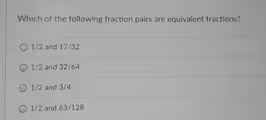
The Correct Answer and Explanation is:
The correct answer is 1/2 and 32/64.
Equivalent fractions are fractions that may look different but have the same value. They represent the same part of a whole. To find the correct pair, we can test each option to see if the two fractions represent the same amount. A common way to do this is by simplifying the more complex fraction or by seeing if you can multiply the numerator and denominator of one fraction by the same number to get the other.
Let’s examine each choice:
- 1/2 and 17/32: For 1/2 to be equivalent to a fraction with a denominator of 32, its numerator would need to be half of 32. Half of 32 is 16. Since the numerator is 17, not 16, the fraction 17/32 is not equivalent to 1/2.
- 1/2 and 32/64: This is the correct pair. We can check this by simplifying the fraction 32/64. To simplify, we find the greatest common number that divides both the numerator (32) and the denominator (64). That number is 32. If we divide the numerator by 32 (32 ÷ 32 = 1) and the denominator by 32 (64 ÷ 32 = 2), we get the fraction 1/2. Because 32/64 simplifies to 1/2, the two fractions are equivalent.
- 1/2 and 3/4: These fractions are not equivalent. The fraction 1/2 is equal to 0.5, while the fraction 3/4 is equal to 0.75. To make 1/2 have a denominator of 4, we would multiply both the top and bottom by 2, which gives us 2/4, not 3/4.
- 1/2 and 63/128: For these to be equivalent, the numerator should be half of the denominator. Half of 128 is 64. The fraction provided is 63/128, which is close but not exactly half. Therefore, this pair is not equivalent.