The Correct Answer and Explanation is:
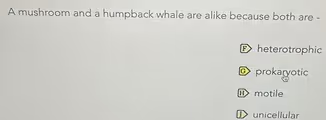
A mushroom and a humpback whale are alike because they are both heterotrophic organisms. This biological term describes an organism that cannot produce its own food and must obtain energy and nutrients by consuming other organic sources. This fundamental characteristic unites organisms from the Fungi and Animalia kingdoms, distinguishing them from autotrophs like plants, which create their own food through photosynthesis.
A mushroom, which is the fruiting body of a fungus, is a prime example of a heterotroph that acts as a decomposer, or saprotroph. Fungi lack chlorophyll and cannot perform photosynthesis. Instead, they release digestive enzymes into their environment, such as soil or a decaying log. These enzymes break down complex organic compounds into simpler, soluble molecules. The mushroom then absorbs these nutrients through its vast network of thread-like structures called hyphae. This process of external digestion is essential for nutrient cycling in ecosystems.
A humpback whale, a member of the Animalia kingdom, is also a heterotroph, but it functions as a consumer. It obtains its energy by actively ingesting other living things. Humpback whales are known as filter feeders. They take in massive mouthfuls of ocean water and use their baleen plates, which are comb-like structures in their mouths, to filter out and consume large quantities of krill, plankton, and small fish. This method of consumption provides the whale with the necessary organic material to fuel its large body and active lifestyle.
The other options are incorrect. Both mushrooms and whales are eukaryotic, not prokaryotic, meaning their cells have a true nucleus. While a whale is motile (capable of movement), a mushroom is sessile (fixed in place). Lastly, both are large, complex multicellular organisms, not unicellular. Thus, their shared method of acquiring nutrition as heterotrophs is the correct likeness.