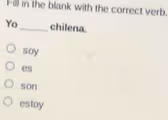
The Correct Answer and Explanation is:
The correct answer is soy.
The completed sentence is: Yo soy chilena.
This question tests the fundamental Spanish concept of choosing between the two verbs that mean “to be”: ser and estar. The correct choice depends entirely on the context.
The verb ser is used to describe essential, permanent, or long term characteristics. This includes aspects of identity like nationality, profession, physical descriptions, personality traits, and origin. In the sentence “Yo ___ chilena,” the word “chilena” (Chilean) describes the speaker’s nationality. Since nationality is a core part of a person’s identity and does not typically change, the verb ser is required. The sentence has the subject “Yo” (I), and the correct first person singular conjugation of “ser” is soy.
Let’s analyze why the other options are incorrect.
- es and son: These are also forms of the verb “ser,” but they are conjugated for different subjects. “Es” is the third person singular form, used with subjects like “él” (he), “ella” (she), or “usted” (you, formal). For example, “Ella es chilena” (She is Chilean). “Son” is the third person plural form, used for “ellos” (they, masculine/mixed), “ellas” (they, feminine), or “ustedes” (you all). For instance, “Ellas son chilenas” (They are Chilean). Neither of these agrees with the subject “Yo.”
- estoy: This is the first person singular form of the verb estar. While the conjugation matches the subject “Yo,” the verb “estar” is used for temporary states, conditions, locations, and emotions. For example, you would say “Yo estoy cansada” (I am tired) or “Yo estoy en la biblioteca” (I am in the library). Using “estoy” to describe nationality, as in “Yo estoy chilena,” would be grammatically incorrect because it implies that being Chilean is a temporary condition, which it is not.
Therefore, “soy” is the only choice that correctly uses the verb “ser” for a permanent characteristic and is properly conjugated for the subject “Yo.”