The Correct Answer and Explanation is:
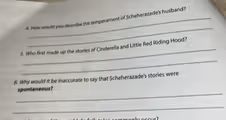
Based on the image provided, here is the answer to question #6, followed by a detailed explanation.
Correct Answer: It would be inaccurate to say that Scheherazade’s stories were spontaneous because they were a meticulously planned and strategically executed tool for her survival and the moral rehabilitation of the king.
Explanation
To describe Scheherazade’s stories as spontaneous fundamentally misunderstands her character, her motivations, and her desperate situation. Her storytelling was the complete opposite of improvisation; it was a calculated, long term strategy designed to save her life and end the murderous reign of King Shahryar.
Firstly, the context of her storytelling left no room for spontaneity. Scheherazade willingly married a king who, betrayed by his first wife, had resolved to marry a new virgin each day and have her executed the following morning. Scheherazade’s life, and the lives of all other potential victims in the kingdom, depended on the success of her plan. To rely on making up a captivating story on the spot under such immense pressure would have been an incredible, and likely fatal, gamble. Her performance had to be flawless every single night for an extended period.
Secondly, the frame story of One Thousand and One Nights explicitly states that Scheherazade was incredibly well prepared. She was not just a clever woman; she was a scholar. The text notes that she had read “the books, annals, and legends of preceding kings, and the stories, examples, and instances of bygone men and things.” She entered the king’s chambers armed with a vast repertoire of tales she had already studied and committed to memory. She was not inventing these stories from nothing but was drawing from a deep well of knowledge she had intentionally accumulated for this very purpose.
Finally, the structure of her storytelling demonstrates immense forethought. Her famous technique of ending each night’s tale on a suspenseful cliffhanger was a deliberate tactic. This method was designed to compel the king to postpone her execution for another day simply to hear the conclusion. She also skillfully wove stories within other stories, a complex narrative device that requires careful planning, not impulsive creation. Her goal was not just entertainment; it was a sustained intellectual and therapeutic effort aimed at healing the king’s broken trust and restoring his humanity. Therefore, her storytelling was an act of profound premeditation, not spontaneity.