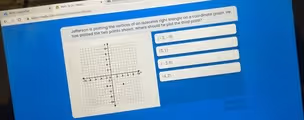
The Correct Answer and Explanation is:
The correct answer is (-2, -9).
To solve this problem, we first need to identify the coordinates of the two points already plotted on the graph. The first point is located at (-2, -3), and the second point is at (4, -3). Let’s call these points A and B, respectively.
The problem asks for a third point, let’s call it C, that will form an isosceles right triangle with points A and B. An isosceles right triangle has two sides of equal length (the legs) that meet at a 90-degree angle.
Let’s analyze the segment AB. Since both points have the same y-coordinate (-3), the line segment connecting them is horizontal. We can find its length by calculating the difference between the x-coordinates: |4 – (-2)| = 6 units.
For the triangle to have a right angle, one of the other sides must be perpendicular to the horizontal segment AB. A perpendicular line to a horizontal line is a vertical line. This means the right angle must be at either point A or point B.
Case 1: The right angle is at point A (-2, -3).
If the right angle is at A, the side AC must be vertical. For the triangle to be isosceles, the length of the vertical leg AC must be equal to the length of the horizontal leg AB, which is 6 units. To find the coordinates of point C, we move 6 units vertically from point A. This gives us two possibilities:
- Moving up 6 units: (-2, -3 + 6) = (-2, 3)
- Moving down 6 units: (-2, -3 – 6) = (-2, -9)
Case 2: The right angle is at point B (4, -3).
If the right angle is at B, the side BC must be vertical and have a length of 6 units. This gives two more possibilities for C:
- Moving up 6 units: (4, -3 + 6) = (4, 3)
- Moving down 6 units: (4, -3 – 6) = (4, -9)
Now we compare our potential points with the given options: (-2, -9), (1, 3), (-2, 9), and (4, 2).
From our calculations, the point (-2, -9) is a valid location for the third vertex. This point creates a triangle with a right angle at A(-2, -3), with two equal legs, AB and AC, both 6 units long. Therefore, (-2, -9) is the correct choice.