The Correct Answer and Explanation is:
The correct answer is False.
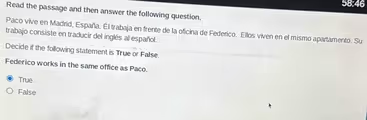
The determination of whether the statement is true or false hinges on a careful reading of the Spanish passage. The statement in question is, “Federico works in the same office as Paco.” To verify this, we must examine the sentence in the text that describes their work locations.
The passage says, “Él trabaja en frente de la oficina de Federico.” This sentence translates to, “He works in front of Federico’s office.” The pronoun “Él” (He) refers to Paco, who was the subject of the previous sentence. The critical phrase here is “en frente de.” In Spanish, this prepositional phrase means “in front of” or “across from.” It explicitly indicates that Paco’s place of work is located opposite or outside of Federico’s office, not within the same space.
If Paco and Federico worked in the same office, the text would have used different phrasing, such as “trabajan en la misma oficina” (they work in the same office) or “trabaja en la oficina con Federico” (he works in the office with Federico). The use of “en frente de” creates a clear distinction between their two separate workplaces.
The other information provided in the passage, such as that they live in the same apartment (“Ellos viven en el mismo apartamento”) and that Paco’s job is translation (“Su trabajo consiste en traducir del inglés al español”), adds context to their relationship but does not alter the facts about their employment locations. While they are roommates, the text makes it clear they are not coworkers sharing an office. Therefore, the statement that Federico works in the same office as Paco is incorrect.