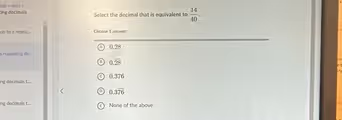
The Correct Answer and Explanation is:
The correct answer is None of the above.
To determine the decimal equivalent of the fraction 14/40, we need to convert the fraction into its decimal form. There are two primary methods to achieve this.
The first method involves simplifying the fraction before converting it. The fraction 14/40 can be simplified by finding the greatest common divisor for both the numerator (14) and the denominator (40). Both numbers are even, so they are divisible by 2. Dividing both parts of the fraction by 2 gives us:
14 ÷ 2 = 7
40 ÷ 2 = 20
This simplifies the fraction to 7/20. To convert this new fraction into a decimal, we can find an equivalent fraction with a denominator that is a power of 10, such as 10, 100, or 1000. We can easily convert the denominator 20 to 100 by multiplying it by 5. To maintain the value of the fraction, we must also multiply the numerator by 5:
7 × 5 = 35
20 × 5 = 100
The equivalent fraction is 35/100. A fraction with a denominator of 100 is read as “hundredths,” which directly translates to the decimal 0.35.
A second method is to use long division, dividing the numerator by the denominator: 14 ÷ 40. Since 14 is smaller than 40, we add a decimal point and a zero to 14, making it 14.0. We then see how many times 40 goes into 140. It goes in 3 times (3 × 40 = 120), leaving a remainder of 20. We bring down another zero to make it 200. Next, we divide 200 by 40, which equals exactly 5. The division terminates, giving us the final result of 0.35.
After calculating the decimal equivalent as 0.35, we compare it to the given options: 0.28 (repeating), 0.28, 0.376, and 0.376 (repeating). Since our calculated value of 0.35 does not match any of these choices, the correct selection is “None of the above.”