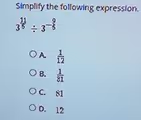
The Correct Answer and Explanation is:
The correct answer is C. 81.
This problem requires simplifying an expression that involves dividing two exponential terms with the same base. The expression is 3^(11/5) ÷ 3^(-9/5). To solve this, we use the quotient rule of exponents.
The quotient rule states that when dividing two powers with the same base, you keep the base and subtract the exponent of the second term from the exponent of the first term. The general formula for this rule is a^m ÷ a^n = a^(m-n).
In this specific problem:
- The common base ‘a’ is 3.
- The first exponent ‘m’ is 11/5.
- The second exponent ‘n’ is -9/5.
Applying the quotient rule, we subtract the exponents:
Expression = 3^((11/5) – (-9/5))
It is important to be careful with the signs. Subtracting a negative number is equivalent to adding its positive counterpart. So, the operation on the exponents becomes an addition:
Exponent = (11/5) + (9/5)
Since the fractions have a common denominator of 5, we can simply add the numerators:
Exponent = (11 + 9) / 5 = 20 / 5
Next, we simplify the fractional exponent:
Exponent = 20 ÷ 5 = 4
Now the original expression is simplified to 3^4. The final step is to calculate the value of 3 to the power of 4, which means multiplying 3 by itself four times:
3^4 = 3 × 3 × 3 × 3 = 81
Therefore, the simplified expression is 81, which matches option C.