The Correct Answer and Explanation is:
The correct answer is D: H₂O and light.
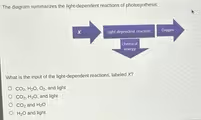
The provided diagram illustrates the inputs and outputs of the light-dependent reactions, which are the first stage of photosynthesis. To determine the correct inputs labeled X, we must understand the role of this stage. The primary purpose of the light-dependent reactions is to capture energy from sunlight and convert it into chemical energy, which will be used in the second stage of photosynthesis.
The two fundamental inputs required for this process are light energy and water (H₂O). Light energy is absorbed by pigment molecules like chlorophyll, located in the thylakoid membranes of chloroplasts. This energy excites electrons, initiating the energy conversion process. Water molecules are also crucial. Through a process called photolysis, which means splitting with light, water molecules are broken down. This splitting releases electrons to replace those lost from chlorophyll, protons (H+ ions) that contribute to an electrochemical gradient, and oxygen gas (O₂) as a waste product. The diagram correctly shows oxygen as an output, which directly confirms that water must be an input.
The other options are incorrect for specific reasons. Carbon dioxide (CO₂) is a primary input for the second stage of photosynthesis, the light-independent reactions or Calvin cycle, where it is used to build sugar molecules. It is not directly used in the light-dependent reactions. Therefore, any option including CO₂ is incorrect. Option A is also incorrect because it lists oxygen (O₂) as an input, but the diagram clearly shows it as a product. The final outputs of the light-dependent reactions, labeled “Chemical energy,” are the energy-carrying molecules ATP and NADPH, which then power the Calvin cycle. Thus, only water and light serve as the essential external inputs for this initial energy-capturing phase of photosynthesis.