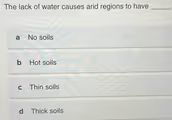
The Correct Answer and Explanation is:
The correct answer is c. Thin soils.
The lack of water in arid regions is the primary limiting factor for soil development, resulting in soil profiles that are characteristically thin and poorly developed. Soil formation, a process known as pedogenesis, relies heavily on two key mechanisms: the weathering of parent rock and the accumulation of organic matter. Water is absolutely essential for both of these processes to occur effectively.
First, water is the main agent of chemical weathering, which involves the chemical decomposition of rock minerals into the finer particles that constitute soil. In dry climates, the scarcity of water means that chemical weathering proceeds at an exceptionally slow rate. As a result, the production of new soil material from the underlying bedrock is severely limited. Physical weathering, such as from temperature fluctuations, may be more dominant, but it does not create the rich mineral composition of well-developed soils.
Second, water is fundamental for supporting plant life. Arid regions have sparse vegetation due to the constant water deficit. This lack of plant cover means very little organic material, like dead leaves and roots, is available to decompose and become part of the ground. The decomposition of organic matter creates humus, a dark, nutrient rich substance that is a vital component of thick, fertile topsoil. Without a steady supply of plant debris, a rich organic layer, or A horizon, cannot form.
The limited water also inhibits processes like leaching, where water would normally transport minerals downward through the soil profile to create distinct layers. Instead, evaporation often draws mineral salts to the surface. In contrast, regions with ample rainfall experience rapid chemical weathering and support lush vegetation, leading to the creation of deep, thick, and well structured soils over time.