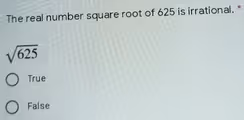
The Correct Answer and Explanation is:
The correct answer is False.
The statement claims that the real number square root of 625 is irrational. To verify this, we must first calculate the square root of 625 and then determine the nature of that number.
The square root of a number is a value that, when multiplied by itself, results in the original number. The mathematical expression for the principal square root of 625 is √625. We are looking for a number ‘x’ where x² = 625. By testing integer values, we can find that 25 multiplied by itself (25 × 25) equals 625. Therefore, the square root of 625 is 25.
Next, we must classify the number 25. The key distinction is between rational and irrational numbers. A rational number is any number that can be expressed as a fraction or ratio of two integers, p/q, where the denominator q is not zero. All integers are rational numbers because any integer ‘n’ can be written as the fraction n/1. Since 25 is an integer, it can be expressed as the fraction 25/1, which makes it a rational number. Rational numbers have decimal representations that either terminate (like 0.5) or repeat a pattern (like 0.333…). The number 25 is a terminating decimal (25.0).
An irrational number, on the other hand, cannot be expressed as a simple fraction of two integers. Its decimal representation goes on forever without repeating. Well-known examples of irrational numbers include pi (π) and the square root of non-perfect squares like √2 or √3.
Since the square root of 625 is exactly 25, and 25 is a rational number, the original statement that “The real number square root of 625 is irrational” is incorrect.