The Correct Answer and Explanation is:
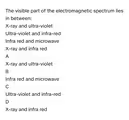
The correct answer is C: Ultra-violet and infra-red.
The visible part of the electromagnetic spectrum lies in between ultraviolet and infrared radiation.
The electromagnetic spectrum is the complete range of all types of electromagnetic radiation, organized in order of increasing frequency and energy, which corresponds to decreasing wavelength. This spectrum encompasses everything from very low-energy radio waves with long wavelengths to extremely high-energy gamma rays with very short wavelengths.
The main sections of the spectrum, starting from the lowest energy and longest wavelength, are: radio waves, microwaves, infrared, visible light, ultraviolet, X-rays, and gamma rays. Visible light, the portion that the human eye can detect, occupies a very narrow band within this vast spectrum.
To understand its position, it helps to look at its neighbors. The region of the spectrum with slightly less energy and a longer wavelength than visible light is called infrared. The name itself provides a clue: “infra” means “below,” so infrared radiation is just below the frequency of red light, which is the color with the longest wavelength in the visible spectrum.
On the other side, the region with slightly more energy and a shorter wavelength than visible light is called ultraviolet. The name “ultra” means “beyond,” indicating that ultraviolet radiation is just beyond the frequency of violet light, which is the color with the shortest wavelength that we can see.
Therefore, the band of visible light, which contains all the colors of the rainbow from red to violet, is situated precisely between the infrared and ultraviolet regions. The other options are incorrect because they either skip over sections of the spectrum or describe incorrect orderings. X-rays have much higher energy than visible light, and microwaves have lower energy than infrared.