The Correct Answer and Explanation is:
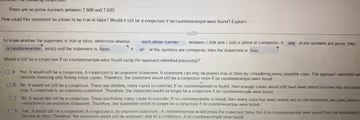
The correct choice is C.
A conjecture is a mathematical statement that is believed to be true but has not yet been formally proven. Conjectures often deal with an infinite number of cases, which makes it impossible to prove them simply by checking every single example. A famous example is the Goldbach Conjecture, which states every even integer greater than 2 is the sum of two primes. Since there are infinite even integers, one cannot test them all.
The statement in question, “There are no prime numbers between 7,608 and 7,620,” is different because it applies to a very small, finite set of integers. The integers in this range are 7609, 7610, 7611, 7612, 7613, 7614, 7615, 7616, 7617, 7618, and 7619. There are only eleven numbers to consider.
The proposed method is to test each of these eleven numbers to determine if it is prime or composite. This process is a proof by exhaustion because it covers every single possible case. If this complete check reveals that none of the numbers are prime (that is, no counterexample is found), then the statement has been definitively proven to be true.
Once a statement is proven, it is no longer a conjecture; it becomes a proven fact or a theorem. Therefore, if no counterexample were found after checking all the numbers, the statement would not still be a conjecture. Option C correctly identifies that there are finitely many cases to consider and that testing all of them constitutes a proof, which means the statement is no longer a conjecture. While the option text contains a likely typo, stating “unproven statement” instead of “proven statement,” its underlying reasoning is the most accurate among the choices.