The Correct Answer and Explanation is:
Here are the correct answers to the questions:
- What is the greatest number of binders Eula can buy? 5
- What is the greatest number of notebooks Eula can buy? 10
- If Eula buys 7 notebooks, what is the greatest number of binders she can buy? 1
Explanation
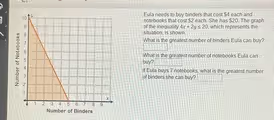
The problem is represented by the inequality 4x + 2y ≤ 20, where x is the number of binders and y is the number of notebooks. The shaded region on the graph shows all the possible combinations of binders and notebooks that Eula can purchase with her $20 budget.
To find the greatest number of binders Eula can buy, we assume she buys zero notebooks. In this case, we set y equal to 0 in the inequality. This gives us 4x + 2(0) ≤ 20, which simplifies to 4x ≤ 20. Dividing both sides by 4, we find that x ≤ 5. This means the maximum number of binders she can buy is 5. On the graph, this point is the x-intercept (5, 0), which is the furthest point on the horizontal “Number of Binders” axis within the shaded area.
To find the greatest number of notebooks Eula can buy, we assume she buys zero binders. We set x equal to 0 in the inequality, resulting in 4(0) + 2y ≤ 20, or 2y ≤ 20. Dividing by 2 gives y ≤ 10. The maximum number of notebooks is 10. This is represented by the y-intercept on the graph at (0, 10), the highest point on the vertical “Number of Notebooks” axis.
For the third question, we are told Eula buys 7 notebooks, so y = 7. We substitute this value into the inequality to find the maximum number of binders she can afford. The calculation is 4x + 2(7) ≤ 20, which becomes 4x + 14 ≤ 20. Subtracting 14 from both sides leaves us with 4x ≤ 6. When we divide by 4, we get x ≤ 1.5. Since Eula cannot purchase half a binder, we must take the greatest whole number that satisfies this condition, which is 1. Therefore, she can buy a maximum of 1 binder if she buys 7 notebooks.