The Correct Answer and Explanation is:
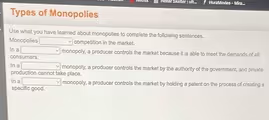
Based on the provided image, here are the correct answers to complete the sentences about the types of monopolies.
- Monopolies limit competition in the market.
- In a natural monopoly, a producer controls the market because it is able to meet the demands of all consumers.
- In a government monopoly, a producer controls the market by the authority of the government, and private production cannot take place.
- In a technological monopoly, a producer controls the market by holding a patent on the process of creating a specific good.
A monopoly is a market structure characterized by a single seller, which means it fundamentally lacks competition. By their very nature, monopolies limit or even eliminate competition, giving the sole producer significant control over prices and supply. Understanding the different ways these structures form is key to identifying them.
A natural monopoly arises when it is more cost effective and efficient for one firm to produce a good or service for an entire market than for multiple firms to compete. This typically occurs in industries with extremely high startup costs and significant economies of scale, such as public utilities like water or electricity distribution. A single company can build the necessary infrastructure to serve everyone, whereas having multiple companies would lead to wasteful duplication and higher average costs for consumers. This efficiency is why one producer is able to meet the demands of all consumers.
A government monopoly is created by law. In this case, the government grants a single firm or entity the exclusive right to provide a specific good or service, explicitly prohibiting any other private production. This may be done to control the supply of essential services, ensure safety standards, or generate state revenue. The United States Postal Service’s exclusive right to deliver first class mail is a classic example of a government sanctioned monopoly.
Finally, a technological monopoly is established when a firm has exclusive control over a particular manufacturing method, invention, or technology. This control is legally protected through patents or copyrights granted by the government. A patent gives an inventor the sole right to make, use, and sell their invention for a limited period, creating a temporary monopoly. This system is designed to encourage innovation by allowing companies to profit from their research and development without immediate competition.