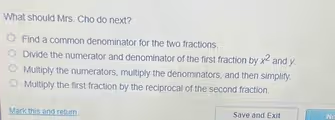
The Correct Answer and Explanation is:
The correct answer is: Multiply the first fraction by the reciprocal of the second fraction.
Explanation:
This question tests the knowledge of the correct procedure for performing arithmetic operations on fractions, specifically algebraic fractions. Although we cannot see the original problem Mrs. Cho is working on, the options provided describe the key steps for different operations. The most logical conclusion is that she is faced with a division problem involving two fractions.
The rule for dividing one fraction by another is to multiply the first fraction by the reciprocal of the second fraction. The reciprocal of a fraction is found by inverting it, meaning the numerator becomes the denominator and the denominator becomes the numerator. For example, if the problem is (a/b) ÷ (c/d), the next step is to change it to (a/b) × (d/c). This procedure is often summarized by the phrase “Keep, Change, Flip.” This is precisely what the correct option describes.
Let’s review the other options to understand why they are likely incorrect:
- Find a common denominator for the two fractions: This is the correct procedure for adding or subtracting fractions, not for division.
- Divide the numerator and denominator of the first fraction by x² and y: This describes a very specific simplification step that would only be applicable if x² and y were common factors in a single fraction. It is not a general rule for an operation between two fractions.
- Multiply the numerators, multiply the denominators, and then simplify: This is the correct procedure for multiplying two fractions. However, if the original problem is division, you must first convert it to a multiplication problem by using the reciprocal. Performing this step directly on a division problem would be incorrect.
Therefore, the essential first step in solving a fraction division problem is to multiply the first fraction by the reciprocal of the second.