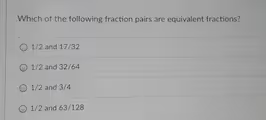
The Correct Answer and Explanation is:
The correct answer is the second option: 1/2 and 32/64.
Equivalent fractions are fractions that represent the same value or proportion, even though they are written with different numbers. There are several ways to determine if a pair of fractions are equivalent.
One common method is to simplify the more complex fraction to its lowest terms. Let’s analyze the correct pair, 1/2 and 32/64. The fraction 1/2 is already in its simplest form. We can simplify the fraction 32/64 by finding the greatest common factor for both the numerator (32) and the denominator (64). The largest number that divides evenly into both is 32. When we divide the numerator by this factor (32 ÷ 32 = 1) and the denominator by the same factor (64 ÷ 32 = 2), we get the fraction 1/2. Since simplifying 32/64 results in 1/2, the two fractions are equivalent.
Another way to check for equivalence is to see if you can multiply the numerator and denominator of the simpler fraction by the same number to get the more complex fraction. Starting with 1/2, we can ask what we need to multiply the denominator (2) by to get the other denominator (64). The answer is 32, since 2 × 32 = 64. To keep the fraction’s value the same, we must also multiply the numerator (1) by 32. This gives us 1 × 32 = 32. This confirms that 1/2 is equivalent to 32/64.
The other options are incorrect. For the first pair, 17/32 is not equivalent to 1/2 because half of 32 is 16, not 17. For the third pair, 1/2 and 3/4 are different values; 1/2 is equal to 0.5, while 3/4 is 0.75. For the last pair, 63/128 is very close to 1/2, but not exact, as half of 128 is 64.