The Correct Answer and Explanation is:
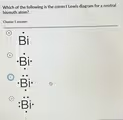
The correct Lewis diagram for a neutral bismuth atom is the third option, which shows the chemical symbol Bi surrounded by five dots.
To determine the correct Lewis diagram for any element, we must first find its number of valence electrons. Valence electrons are the electrons located in the outermost energy shell of an atom, and they are the ones that participate in chemical bonding. The Lewis diagram is a simple visual representation of these specific electrons.
The most straightforward way to find the number of valence electrons for a main group element is to locate it on the periodic table. Bismuth, with the chemical symbol Bi, is in Group 15 of the periodic table. For main group elements, the group number directly corresponds to the number of valence electrons. Therefore, all elements in Group 15, which includes nitrogen, phosphorus, arsenic, and bismuth, have five valence electrons.
Once we know the atom has five valence electrons, we can construct its Lewis diagram. The process begins with writing the element’s chemical symbol, in this case, Bi. Then, we place the valence electrons as dots around the symbol. According to convention, we place one dot on each of the four sides (top, bottom, left, and right) before we begin pairing them up. With five electrons, we would place one dot on each of the four sides, and the fifth dot would then pair up with one of the first four. This results in one pair of electrons and three single, unpaired electrons.
The third option in the image correctly depicts this configuration: the symbol “Bi” is shown with one pair of dots and three individual dots, for a total of five valence electrons. The other options are incorrect because they show different numbers of valence electrons, which would represent elements from other groups on the periodic table.