The Correct Answer and Explanation is:
Of course. Here is the correct answer and a detailed explanation of the process.
Answer:
9.8n – 9p – 9.9
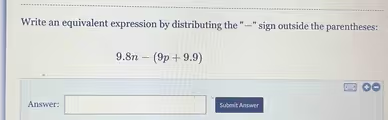
To find the equivalent expression for 9.8n – (9p + 9.9), you need to apply the distributive property. The instruction specifically asks to distribute the negative sign that is located just outside the parentheses. Distributing a negative sign across a set of terms in parentheses means you multiply each term inside the parentheses by negative one. This effectively changes the sign of every term within the parentheses.
Let’s break down the original expression: 9.8n – (9p + 9.9).
The first term, 9.8n, is outside the parentheses, so it remains unchanged during the distribution process.
Next, we focus on the part of the expression involving the parentheses: -(9p + 9.9).
- Identify the terms inside the parentheses. The terms are 9p and +9.9.
- Distribute the negative sign to the first term, 9p. A positive 9p becomes a negative 9p, which we write as -9p.
- Distribute the negative sign to the second term, +9.9. The positive 9.9 becomes a negative 9.9, which we write as -9.9.
Now, you can rewrite the entire expression without the parentheses, using the new terms you have just calculated. You combine the initial term with the results of the distribution.
The original 9.8n stays the same. The -(9p + 9.9) becomes -9p – 9.9.
Putting it all together, the final equivalent expression is 9.8n – 9p – 9.9.
This expression cannot be simplified any further because there are no like terms. The term 9.8n contains the variable n, the term -9p contains the variable p, and -9.9 is a constant. Since each term is distinct, they cannot be combined.