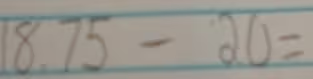
The Correct Answer and Explanation is:
The correct answer is -1.25.
The image displays a handwritten mathematical equation: 18.75 – 20. This problem requires subtracting a larger number, 20, from a smaller number, 18.75. A key principle in arithmetic is that when you subtract a larger value from a smaller one, the result will always be a negative number.
To solve this, a simple approach is to first find the difference between the two numbers and then apply the negative sign. We can reverse the operation to subtract the smaller number from the larger one, which is an easier calculation to perform: 20 – 18.75.
To subtract these numbers, it is helpful to align them by their decimal points. We can write 20 as 20.00 to make the subtraction clear.
The calculation is as follows:
20.00
- 18.75
We start with the rightmost column, the hundredths place. Since 0 is smaller than 5, we need to borrow from the column to the left. The tenths place is also 0, so we must continue to borrow from the ones place, and ultimately from the tens place. After borrowing, or regrouping, the number 20.00 can be thought of as 19 and 100 hundredths, or more specifically, 1 ten, 9 ones, 9 tenths, and 10 hundredths.
Now the subtraction is straightforward:
In the hundredths place: 10 – 5 = 5.
In the tenths place: 9 – 7 = 2.
The decimal point remains in the same position.
In the ones place: 9 – 8 = 1.
In the tens place: 1 – 1 = 0.
The result of this subtraction is 1.25. However, this is just the magnitude of the difference. Since the original problem was 18.75 – 20, where a larger number was subtracted from a smaller one, the final answer must be negative. Therefore, we apply the negative sign to our result, giving us the final answer of -1.25.