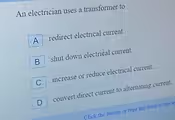
The Correct Answer and Explanation is:
The correct answer is C: increase or reduce electrical current.
A transformer is a fundamental electrical device that operates on the principle of electromagnetic induction to transfer energy from one alternating current (AC) circuit to another. While it is most commonly described as a device for changing voltage levels, its effect on electrical current is a direct and inseparable consequence of its function.
The relationship between voltage and current within a transformer is governed by the law of conservation of power. In an ideal transformer, the power input to the first coil, known as the primary, is equal to the power output from the second coil, the secondary. Since electrical power is calculated as the product of voltage and current (Power = Voltage × Current), any change in voltage must be accompanied by an inverse change in current to keep the power level constant.
For example, a “step-down” transformer is designed to decrease voltage. To maintain the power balance, it must simultaneously increase the current. An electrician might use this type of transformer for applications like low-voltage lighting or welding, which require a high current at a safe, low voltage.
Conversely, a “step-up” transformer increases the voltage, which consequently reduces the current. This principle is critical for the efficient transmission of electricity over long distances. Power companies use large step-up transformers to raise the voltage to extremely high levels, thereby lowering the current and minimizing the energy lost as heat in the power lines.
The other options are incorrect. Redirecting current is the job of switches and relays. Shutting down current is a safety function performed by circuit breakers and fuses. Converting direct current to alternating current is done by an entirely different device called an inverter. In fact, transformers cannot operate on a steady direct current because they require the changing magnetic field that only alternating current can produce.