The Correct Answer and Explanation is:
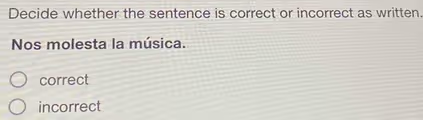
The correct answer is correct.
The sentence “Nos molesta la música” is grammatically correct as written. It translates to “The music bothers us” or “We are bothered by the music.” This sentence structure, which is common with verbs like molestar (to bother), gustar (to like), and encantar (to love), can sometimes be confusing for learners of Spanish because the grammatical roles are different from how they are expressed in English.
To understand why the sentence is correct, we need to analyze its components. In this Spanish construction, the thing that is causing the feeling, “la música” (the music), is the grammatical subject of the sentence. The verb must agree in number with this subject. Since “la música” is a singular noun, the verb must be conjugated in the third-person singular form, which is “molesta.”
The word “Nos” is an indirect object pronoun, and it indicates who is affected by the action. It answers the question “To whom is the music bothersome?” In this case, it means “to us.” A more literal translation that highlights the Spanish grammar would be “The music is bothersome to us.” This phrasing makes it very clear that “the music” is the subject performing the action and “us” is the object receiving the action.
If the subject of the sentence were plural, the verb would change accordingly. For example, if we were talking about multiple loud noises, the sentence would be “Nos molestan los ruidos.” In this example, the verb “molestan” is in the third-person plural form to agree with the plural subject “los ruidos” (the noises).
Therefore, the original sentence “Nos molesta la música” correctly uses the singular verb “molesta” to agree with the singular subject “la música,” making it a perfectly valid Spanish sentence.